Showing posts with label social security blog. Show all posts

Wednesday, January 10, 2018

Adverse Vocational Profiles -- The Inability to Adjust to Other Work

Is a person with a residual functional capacity for medium work ever disabled?  The answer is "yes," tell the ALJ to read the regulations.  We look at the policy changes that came about in 1975 with the advent of the SSI program -- people that don't have enough connection to the work force to have insured status. 

The statute requires consideration of age, education, and work experience in assessing the ability to engage in other work at step five of the sequential evaluation process.  This structure holds true for disability insurance benefits.  The inclusion of a federal SSI program meant that the agency would regularly decide the question of disability for people that lacked relevant work experience.  The regulations describe that adverse profile as calling for a finding of disability beginning at age 55:
If you are at least 55 years old, have no more than a limited education, and have no past relevant work experience. If you have a severe, medically determinable impairment(s) (see §§ 416.920(c)416.921, and 416.923), are of advanced age (age 55 or older, see § 416.963), have a limited education or less (see § 416.964), and have no past relevant work experience (see § 416.965), we will find you disabled. If the evidence shows that you meet this profile, we will not need to assess your residual functional capacity or consider the rules in appendix 2 to subpart P of part 404 of this chapter.
A claimant passing that bright line of age 55, having a limited education or less, with no past relevant work experience, and having a severe impairment has an entitlement to a finding of disability.  That's it, drop the mic and walk away. 

For disability insurance purposes, it is now common for work experience to buy a quarter of coverage and not qualify as past relevant work because the amount earned does not rise to substantial gainful activity.  In 1975, the agency defined SGA as more than $200 per month.  A quarter of coverage cost $250 per month.  A person earning the minimum for SGA needed to work in each quarter of the year to earn four quarters.  In 2018, the agency defines SGA as more than $1,180 per month.  A quarter of coverage costs $1,320 in 2018.  But the person need not work in every quarter; earnings are annualized so that $5,280 earned in five months purchases four quarters of coverage.  A claimant can work at non-SGA amounts for five months a year and earn four quarters of coverage.  It is now easier to purchase insured status without every accumulating PRW.  The adverse vocational profile comes up more often now even in disability insurance benefit cases. 

The keys that unlock the doors of relevance of work experience rest in the earning as we just discussed but also in the concepts of duration and recency.  Recency represents the most common problem of PRW in SSI cases.  When we see a finding of ability to perform PRW in SSI cases, we should always comb the earnings record for earnings and recency even for unskilled work experience. Nor do we have to look very hard; the vocational profile regulation tells us where to look for that three-part test of relevance of past work. 

We need to remain vigilant for the adverse vocational profiles for claimants over the age of 55 and having not more than a limited education.  Does the claimant have relevant work experience?  If  not, a step two finding of a medically determinable severe impairment terminates the inquiry with a finding of disability.  See also the medical-vocational guidelines, rules 201.01, 202.01, 203.01, 203.02, and 203.10 that direct the same findings for the adverse profiles at step five.  For a further explanation of the adverse profile case, see the Social Security Ruling

Sunday, December 31, 2017

The Occupation-Industry Matrix Gives a Labor Check on Census Numbers

We looked yesterday at the tobacco industry.  I know, some of you are saying, "but that was the last post of the year."  Changed my mind, fickle like that. 

The Census Bureau gave us 2015 job numbers for the tobacco industry of 13,872. 


BLS told us that there were 600 hand laborers and 100 hand packers.  To get those numbers, we used the employment projections sorted by occupation and scrolled to the line for NAICS 312200, tobacco manufacturing.  The BLS provides another useful tool that checks that 13,872 and tells us at a glance how the industry staffs itself:  the occupation-industry matrix by industry.  The industry sort has the line for tobacco manufacturing and the XLSX link to the data. 

BLS reports 2016 industry employment of 12,900 jobs.  That is less than 10% difference, looking at 2015 versus 2016.  BLS projects that the industry will continue to shrink to about 8,000 jobs in 2026.  BLS reports the data for the industry in red, to tell us without reading that this industry is going up in smoke. 

The industry sort gives additional data that makes sense of occupational data from the occupation sort and CBP.  By making sense of the data, I mean ripping the lies out of the vocational expert's mouth. 

Saturday, December 30, 2017

ALJ Says that Leaf Tier Exists in Significant Numbers -- Based on His Anecdotal Experience

The ALJ practiced in Kentucky and he knows that tobacco is a big industry.  There are a couple of problems with his personal opinion.  The first is that the ALJ is wrong. 

Agricultural jobs are seasonal.  The people that pull tobacco (yes, that is the right word, harvesting tobacco is pulling the leaves) do so when the plant is ready for harvest.  It isn't a permanent job that exists in March of any year when County Business Patterns establishes its statistics.  Seasonal work can be relevant.  But agricultural work rides the different harvesting cycles of different crops in different areas.  The Wiki, citing the New York Times, says that tobacco farms employ 30,000 workers annually.  This ranges from planting, cultivating, topping, suckering, and pulling.  The DOT lists the titles and alternate titles that exist in the tobacco farming industry:
TOBACCO CURER 523.682-038
Tobacco Farmworker 404.687-010
Tobacco Grader 409.687-010
Tobacco Grower 404.161-010
Tobacco Packer 920.687-134
TOBACCO-WAREHOUSE AGENT 259.357-038
Tobacco Weigher 222.387-074
TOBACCO BLENDER 790.381-010
TOBACCO-CLOTH RECLAIMER 589.686-050
None of these occupations work in the stemming and manufacturing of cigarettes, cigars, chewing tobacco. smoking tobacco, and snuff.  The Appendix for Occupational Titles Arranged by Industry Designation in the DOT lists 390 occupations involved in the tobacco manufacturing industry.  And no, I did not count them.  I copied and pasted into an excel spreadsheet and let software count for me.  

That long list includes hand bander and leaf tier.  

    Wraps trademark band around cigars: Moistens or applies paste to tip end of band and presses ends of band together around cigars. Places banded cigars aside for further processing. 
GOE: 06.04.38 STRENGTH: S GED: R2 M1 L1 SVP: 2 DLU: 77


    Ties tobacco leaves in hands (bundles) to facilitate processing: Selects loose leaves for hand and arranges leaves with butt ends together. Winds tie leaf around butts and pulls end of tie leaf into hand.  GOE: 06.04.28 STRENGTH: S GED: R1 M1 L1 SVP: 1 DLU: 77
 
So back to the ALJ and his personal experience living around the tobacco agricultural industry.  These two occupations are not in the agricultural industry.  These are manufacturing jobs per the DOT.  

County Business Patterns states that as of March 12, 2015, the entire tobacco manufacturing industry employed a grand total of 13,872 people.  


The OOH puts both of these groups into hand laborers and material movers.  The OOH says:
Hand laborers and freight, stock, and material movers move materials to and from storage and production areas, loading docks, delivery trucks, ships, and containers. Although their specific duties may vary, most of these movers, often called pickers, work in warehouses. Some workers retrieve products from storage and move them to loading areas. Other workers load and unload cargo from a truck. When moving a package, pickers keep track of the package number, sometimes with a hand-held scanner, to ensure proper delivery. Sometimes they open containers and sort the material.
Hand packers and packagers package a variety of materials by hand. They may label cartons, inspect items for defects, and keep records of items packed. Some of these workers pack materials for shipment and move them to a loading dock. Hand packers in grocery stores, also known as grocery baggers, bag groceries for customers at checkout.

Industry 2016
Code Title Employment        Percent of             industry Percent of occupation
TE1000 Total employment 2,628.40        1.7     100
312200
Tobacco manufacturing
0.6         5        0

All hand laborers in the tobacco manufacturing industry, from sedentary to heavy and from unskilled to skilled, represent 600 jobs.  

Industry 2016
Sort Order Code Title Employment Percent of industry Percent of occupation
1 TE1000 Total employment 710.8 0.5 100.0
25 312200
Tobacco manufacturing
0.1 0.9 0.0

All hand packers in the tobacco manufacturing industry, from sedentary to heavy and from unskilled to skilled, represent 100 jobs.

There are a lot of laborers and packers, just not in the tobacco industry.  

Hand laborers don't sit more than 40% of the day or about 3.2 hours.  

Hand packagers sit less, about 10% of the day or about 0.8 hours.  

The ALJ did concede that the tobacco manufacturing jobs probably weren't sedentary.  So he does have that right.  


Saturday, December 23, 2017

Defining Terms - Critical to Proving Disablity

Moderate, simple, routine ... these are just some of the terms that we read and hear in medical records and testimony.  I know what I mean when I use those words, but I am not sure what anyone else means when they use what are essentially terms of art.  The rescinded SSR 96-5p cautioned agency adjudicators against assuming that they know what witnesses meant when using banal terms like light.  The Commissioner promises to provide guidance later on that issue:
However, we are not revising our rules to add text about considering context or to provide examples because we intend to further clarify and provide examples, as appropriate, in our subregulatory instructions.

This draws into focus the need for the representative to demand that medical and non-medical sources define their terms.  Objective phrases need no definition -- 20 pounds.  Periodicity terms have context.  In California workers' compensation, occasional means up to 25% of the day; intermittent means up to 50% of the day; and frequent means up to 75% of the day.  Under that same regulation, a slight pain causes some handicap and a moderate pain causes a marked handicap in the activities percipitating the pain.  The terms have different meanings even though they sound the same that requires a great deal of care in assessing and ascertaining what the doctors meant.  I wrestled with this 20 years ago in Desrosiers v. Secretary of HHS.  The enduring concept of context and that context matters a great deal endures.  

The context bringing the matter to a boil today occurs in a hearing with an awful ALJ from San Francisco.  The ALJ calls a psychiatric medical expert.  ALJs call medical experts to either lock down a denial or to provide a basis to pay and the inherent bias of that ALJ dictates the reason.  The ALJ is looking for a way to deny.  The medical expert testifies to the conclusion that the person could perform simple, repetitive tasks.  If he had left it there, the claimant would have lost on SRT sedentary work.  That work doesn't exist anymore but it takes a Shaibi analysis to prove it.  

But this ALJ really wanted to lock it down, not knowing that he tied his own rope.  
By simple, repetitive tasks, do you mean one and two steps for unskilled work or do you mean three and four steps for semiskilled work?
The medical expert does not respond with unskilled.  The medical expert defines simple, repetitive tasks as one and two steps.  This took the case from eliminating reasoning level 3 work under Zavalin to eliminating reasoning level 2 work under Rounds.  Maybe not eliminating, but at least requiring a reasonable explanation.  Vocational experts rarely confess their deviation and cling to the idea that the DOT is soft and that anything other than a sit-stand option requires no explanation.  After all, "I have 30 years of experience."  

Here the ALJ in one question disclosed his patent bias and latent misunderstanding of the world of work.  I already knew he was a low paying, ready to deny, not a nice guy of an ALJ.  But now I know that he thinks that unskilled work is one- and two-step instructions and that anything beyond that is semi-skilled.  He hasn't read the DOT, is unaware of the world of work, and wants to deny anyone limited to one- and two-step work with identification of cashiers, furniture clerks, and others.  

This colloquy between an ALJ and medical expert racing down the track to hurry up and deny the claim reinforced the need to define the terms and just how important our job is to disabuse those ALJs of their misunderstanding of work and disability.  

Wednesday, December 20, 2017

Judge Says He Has No Discretion to Roll Back Three Months

Yep, that is what the ALJ told me in a pre-hearing conference.  I was taken aback.  That isn't my recollection and I have a grasp of the regulations.   Client turned 55 some eight years ago, three months after the date last insured.  I expect a grid finding on the remote onset at the DLI so the judge's statement leaves me scratching my head.  My client was in the waiting room reviewing her E exhibit statements in this USDC remand. I pull out my Google Pixel phone and I do what every representative should do, google it. 

Tying it in:  Social Security Ruling ... no, that isn't right, it is in HALLEX.  Start over:  HALLEX borderline age.  Boom  Feeling like I might have missed something so I verbally dance while reading quickly on the first entry:  HALLEX I-2-2-42.  "Judge, the HALLEX says you have discretion at a few months before the age change to find disability as of the date last insured." 

Judge asks for the cite.  HALLEX I-2-2-42 paragraph B, 1, second bullet.  "You have it backwards counsel."  Deep breath.  Just read the pertinent parts out loud and the judge will get it:

ALJs will assess whether the claimant reaches or will reach the next higher age category within a few days to a few months after the:
 . Date last insured;

Judge reads along.  "Oh, I read that wrong before.  I stand corrected.  Go get your client." 

Win. 

Serendipity for the day:  HALLEX refers to POMS DI 25015.006 for additional guidance on the borderline age situation.  Need to remember that the next time an ALJ tells me that the corps is not bound by POMS.  

Lesson for the day, the ALJ will get it absolutely legally wrong.  Don't back down; correct the mistake.  Use your smartphone or other device.  It is impossible to anticipate every wrong thing a judicial officer or witness might say.  It is our obligation to correct on the fly and dance like a person possessed as we figure it out. 

Thursday, December 14, 2017

Preschool Teacher -- Not Light Work -- Rebut the DOT

I am getting ready for a hearing but you really need to know this.  You can rebut the DOT.  My case is for a preschool teacher of advanced age and capable of light work.  I expect the vocational expert to tell the ALJ that the job is light per the DOT and thus as generally performed.

    Instructs children in activities designed to promote social, physical, and intellectual growth needed for primary school in preschool, day care center, or other child development facility. Plans individual and group activities to stimulate growth in language, social, and motor skills, such as learning to listen to instructions, playing with others, and using play equipment. May be required to have certification from state. May be designated Teacher, Child Development Center (education); Teacher, Day Care Center (education); Teacher, Early Childhood Development (education); Teacher, Nursery School (education).
GOE: 10.02.03 STRENGTH: L GED: R4 M2 L3 SVP: 7 DLU: 81

There it is light.  But is it.  I checked the Occupational Requirements Survey published by the Bureau of Labor Statistics.  


Latest Observation:Annual 201730.00

Annual 2017 - Annual 2017Minimum Value: Annual 201730.00
Maximum Value: Annual 201730.00
Data Availability:2017 - 2017
Data extracted on: Dec 14, 2017 (11:24:47 AM)
Occupational Requirements Survey

Series Title:Civilian workers; preschool teachers, except special education; pounds maximum weight lifted/carried (25th percentile)
Series ID:ORUP1000037400000235
Seasonality:Not Seasonally Adjusted
Survey Name:Occupational Requirements Survey
Measure Data Type:Pounds
Industry:All workers
Occupation:Preschool Teachers, Except Special Education
Class of Worker:All workers
Requirements:Physical demands
Type of cases:Maximum weight lifted/carried

That is the 25th percentile and 30 pounds is well beyond light.  


Latest Observation:Annual 201740.00

Annual 2017 - Annual 2017Minimum Value: Annual 201740.00
Maximum Value: Annual 201740.00
Data Availability:2017 - 2017
Data extracted on: Dec 14, 2017 (11:26:14 AM)
Occupational Requirements Survey

Series Title:Civilian workers; preschool teachers, except special education; pounds maximum weight lifted/carried (50th percentile - median)
Series ID:ORUP1000037400000236
Seasonality:Not Seasonally Adjusted
Survey Name:Occupational Requirements Survey
Measure Data Type:Pounds
Industry:All workers
Occupation:Preschool Teachers, Except Special Education
Class of Worker:All workers
Requirements:Physical demands
Type of cases:Maximum weight lifted/carried
That is the 50th percentile.  As generally performed, the work is not light.  


Latest Observation:Annual 201780.8

Annual 2017 - Annual 2017Minimum Value: Annual 201780.8
Maximum Value: Annual 201780.8
Data Availability:2017 - 2017
Data extracted on: Dec 14, 2017 (11:27:22 AM)
Occupational Requirements Survey

Series Title:Civilian workers; % of preschool teachers, except special education; strength is medium work
Series ID:ORUP1000037400000663
Seasonality:Not Seasonally Adjusted
Survey Name:Occupational Requirements Survey
Measure Data Type:Percentage
Industry:All workers
Occupation:Preschool Teachers, Except Special Education
Class of Worker:All workers
Requirements:Physical demands
Type of cases:Strength
Now that is definitive.  Preschool teachers require medium exertion.  The DOT is rebutted by governmental data.  


Latest Observation:Annual 201715.8

Annual 2017 - Annual 2017Minimum Value: Annual 201715.8
Maximum Value: Annual 201715.8
Data Availability:2017 - 2017
Data extracted on: Dec 14, 2017 (11:28:28 AM)
Occupational Requirements Survey

Series Title:Civilian workers; % of preschool teachers, except special education; strength is light work
Series ID:ORUP1000037400000662
Seasonality:Not Seasonally Adjusted
Survey Name:Occupational Requirements Survey
Measure Data Type:Percentage
Industry:All workers
Occupation:Preschool Teachers, Except Special Education
Class of Worker:All workers
Requirements:Physical demands
Type of cases:Strength
Makes sense, some preschool teachers engage in light exertion.  We get past step four and straight into step five.  Transferability is present but it is one occupation.  That does not qualify as a range of work.  

Telephone Quotation Clerk as Representative of Other Unskilled Information Clerks


A pure DOT-based assault on the vocational expert's identification of an occupation followed by the dance off the hook, it represents other occupations in other industries.  The depth of vocational expert push to identify work regardless of the truth and to defend the indefensible never surprises me, anymore.  I expect it.  

The vocational expert testified to information clerk, DOT 237.367-046.  This identification came in response to a question that assumed a range of sedentary work with simple, repetitive tasks.  

237.367-046 TELEPHONE QUOTATION CLERK (financial) alternate titles: information clerk, brokerage; quote clerk; telephone-information clerk
    Answers telephone calls from customers requesting current stock quotations and provides information posted on electronic quote board. Relays calls to REGISTERED REPRESENTATIVE (financial) 250.257-018 as requested by customer. May call customers to inform them of stock quotations.
GOE: 07.04.04 STRENGTH: S GED: R3 M2 L3 SVP: 2 DLU: 77

The vocational expert identified this occupation as requiring reasoning level 2.  The DOT describes the work as requiring reasoning level 3.  The DOT defines reasoning level as:

03 LEVEL REASONING DEVELOPMENT
Apply commonsense understanding to carry out instructions furnished in written, oral, or diagrammatic form. Deal with problems involving several concrete variables in or from standardized situations.

02 LEVEL REASONING DEVELOPMENT
Apply commonsense understanding to carry out detailed but uninvolved written or oral instructions. Deal with problems involving a few concrete variables in or from standardized situations.

01 LEVEL REASONING DEVELOPMENT
Apply commonsense understanding to carry out simple one- or two-step instructions. Deal with standardized situations with occasional or no variables in or from these situations encountered on the job.

Quotation clerk or information clerk is not simple, repetitive work.  The testimony conflicts with and fails to provide a reasonable basis for resolving that conflict.  20 C.F.R. § 404.1566(d)(1); Social Security Ruling 00-4p.

The vocational expert conceded that the occupation with a primary function of answering phone calls for current stock quotations and providing information posted no longer exists.  The vocational expert suggested that other types of information giving clerks could exist in the national economy.  The testimony lacks specificity and did not rely on a labor market survey.  

An information clerk in the clerical industry (and thus applicable across industry lines) requires reasoning level 4 and is semi-skilled. 

237.367-022 INFORMATION CLERK (clerical)
    Answers inquiries from persons entering establishment: Provides information regarding activities conducted at establishment, and location of departments, offices, and employees within organization. Informs customer of location of store merchandise in retail establishment. Provides information concerning services, such as laundry and valet services, in hotel. Receives and answers requests for information from company officials and employees. May call employees or officials to information desk to answer inquiries. May keep record of questions asked.
GOE: 07.04.04 STRENGTH: S GED: R4 M2 L3 SVP: 4 DLU: 86

The oft-cited information clerk in thetransportation-related industries requires reasoning level 4 and requires light exertion because of the standing. 

237.367-018 INFORMATION CLERK (motor trans.; r.r. trans.; water trans.) alternate titles: travel clerk
    Provides travel information for bus or train patrons: Answers inquiries regarding departures, arrivals, stops, and destinations of scheduled buses or trains. Describes routes, services, and accommodations available. Furnishes patrons with timetables and travel literature. Computes and quotes rates for interline trips, group tours, and special discounts for children and military personnel, using rate tables.
GOE: 07.04.04 STRENGTH: L GED: R4 M2 L3 SVP: 2 DLU: 77

The vocational expert’s concession that the telephone quotation clerk does not continue to exist as described in the DOT but that other occupations provide information over the telephone finds its answer in the DOT — information clerks are semi-skilled and require reasoning level 4.  The failure of the vocational expert to identify the occupation identified as requiring reasoning level 3 provides ample basis to conclude that the occupation fails to meet the requirements of the hypothetical posed.  

Sunday, December 10, 2017

Boat Rental Clerk -- Completely Specious per the CBP

Some chatter here and there about vocational experts identifying boat-rental clerk as a viable occupation. The DOT describes the occupation:

295.467-014 BOAT-RENTAL CLERK (amuse. & rec.)
    Rents canoes, motorboats, rowboats, sailboats, and fishing equipment: Explains rental rates and operation of boats and equipment to customer. Assists customers in and out of boats. Launches and moors boats. Tows disabled boats to shore, using motorboat. Calculates rental payment and collects payment from customer. May make minor adjustments and repairs on motors of motorboats, such as replacing battery, using handtools. May pump water out of boats, using mechanical pump. 
GOE: 09.04.02 STRENGTH: L GED: R3 M3 L3 SVP: 2 DLU: 77

This description speaks to the rental of watercraft to the consuming public. We know that boat-rental clerk belongs to SOC 41-2021. The OOH tells us that the occupational group has 458,200 jobs in the nation as of 2016.

So far into the weeds, the occupation seems viable. The Census Bureau describes the probable industry:

532284 Recreational Goods Rental

This U.S. industry comprises establishments primarily engaged in renting recreational goods, such as bicycles, canoes, motorcycles, skis, sailboats, beach chairs, and beach umbrellas.

The industry includes pleasure boat rental, yacht rental, and other boats. We can consider and exclude
--

532411 Commercial Air, Rail, and Water Transportation Equipment Rental and Leasing

This U.S. industry comprises establishments primarily engaged in renting or leasing off-highway transportation equipment without operators, such as aircraft, railroad cars, steamships, or tugboats.

This industry excludes pleasure craft and includes commercial watercraft. There aren't any other boat rental industries.

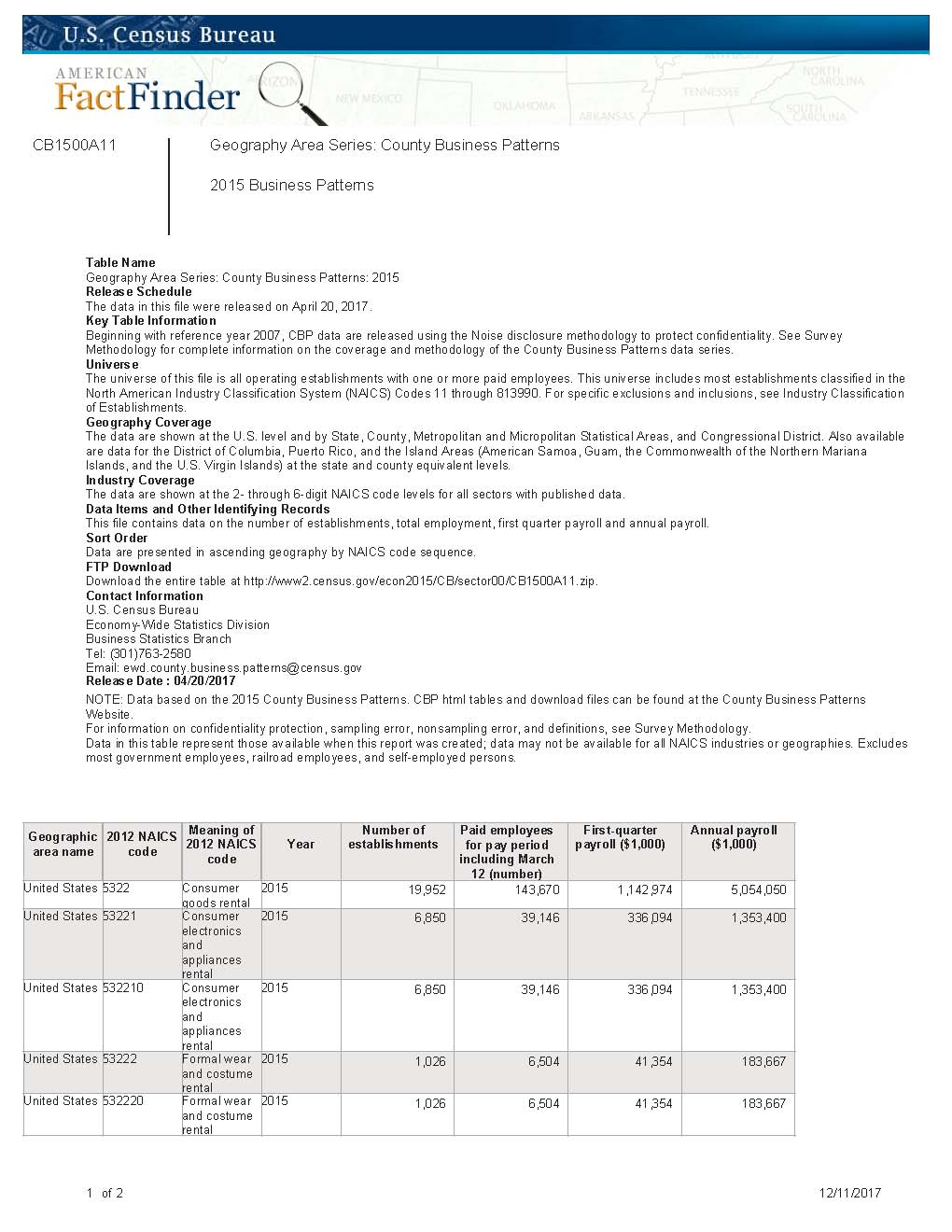
County Business Patterns does not list 532284. It lists recreational good rental under code 532292. The industry employs 9,142 people in the nation. The employment projections state that counter and rental clerks represent less than 23% of the workers in the industry group, 532200. That takes the number of jobs to less than 2,300 jobs (rounding way up). This industry designation includes beach chairs and umbrellas, bicycles, exercise equipment, golf carts, moped, jet skis and wave riders, ski equipment, surfboards, and water skis. The number of jobs as a boat-rental clerk is insignificant.

Wednesday, December 6, 2017

Harry Pregerson ... An Icon of the Ninth Circuit

I read with sadness the passing last month of Judge Harry Pregerson.

I argued many cases in front of Judge Pregerson over the years, some of them published.  My most memorable argument came in Cooper v. Sullivan.  The court set the case for argument on October 6, 1988.  My bar card was still moist, two months shy of my third anniversary as a lawyer.

Cooper arose from the Central District of California.  That meant that argument would take place in Pasadena.  Central District cases get argued in Pasadena.  So on October 6, I drove to the beautiful Pasadena Courthouse of the Ninth Circuit.  The parking lot was particularly light that day.  The marshals let me in and had a peculiar look about them.  Something was wrong.

The counter always had the calendar for the different courtrooms.  There weren't any.  I opened my large briefcase and pulled out the latest volume of my paper file.  Yep, there it is in black and white -- the court set argument for October 6, 1988, at 1:30 pm ... oh no, in San Francisco.

I pulled a couple of quarters out of my pocket and used one of those old fashioned pay phones and called my office.  "Tell the court I blew it.  Tell the court I am in Pasadena."  I hurriedly drove back to Santa Fe Springs.  When I arrived, my secretary told me that court wanted me in San Francisco, tomorrow, at noon, to argue Cooper.

I got on the airplane the next morning and went to San Francisco.  Dennis Mulshine was there in the hallway.  We were told to wait until the court finished its docket for the day.  We would argue in the chief judge's chambers.  Judges Reinhardt, Noonan, and Pregerson along with a cadre of others including Dennis and me walked down the halls of the courthouse to the chief ... it changed that year from Judge Browning to Goodwin.

As we walked down the hall, I strode next to Judge Pregerson.  He started talking to me.  I didn't know what to do.  Judge Pregerson says, "you know, we were going to leave a message for you ... that today, we were in Pasadena" and then he broke out laughing.

Judge Pregerson was a great judge.  He crafted the law in important ways that will reverberate for years or decades to come.  The court is lessened by his loss.  And so is the entire legal profession.