Showing posts with label cross-examination. Show all posts

Friday, May 10, 2019

Case Study -- Younger Individual, Limited Range of Light, Non-Exertional Impairments

Sometimes the resources of the O*NET and ORS just are not useful.  Take the example of a younger individual with a limited range of light.  ALJ asks the questions that don't get "there."  The ALJ asked eight hypothetical questions. 
1. Seizure precautions - past work available.
2. 1+ medium work - past work available.
3. 1+ light work - no past work, but other work as an information clerk; ticket taker; and parking lot attendant.
4. 3+ limited to four hours of standing and walking - other work as an information clerk; ticket taker; and parking lot attendant.
5. One absence a month - no change.
6. Two absences a month - no work.
7. Off task 5% of the day - other work as an information clerk; ticket taker; and parking lot attendant.
8. Off task 10% of the day - no work.
Cross-examination considers first -- can we knock this down to sedentary.  The SSA form says 2 hours of standing and separately 2 hours of walking. 
9. Seizure precaution and two hours of standing/walking combined - other work as an information clerk; ticket taker; and parking lot attendant.  
I know that information clerks and receptionists have a broad range of sitting and it does not matter if the work is light or sedentary.  VE confirms that these three occupations can sit all day. There is no medical evidence of a sitting limitation.  Move one. 
10.  Extreme limitations in the social functioning caused by poor judgment - no jobs.  
That is what the psychiatrist CE said.  The answer is expected.  Idle it back. 
11. Marked limitations in the social functioning caused by poor judgment - no jobs. 
12. Moderate limitations in the social functioning caused by poor judgment, chronic and recurring - no jobs.  
The minimalist approach works. 
13.  Rare, once a week, inappropriate with supervisors in accepting instruction and responding appropriately to criticism from supervisors - no jobs.  
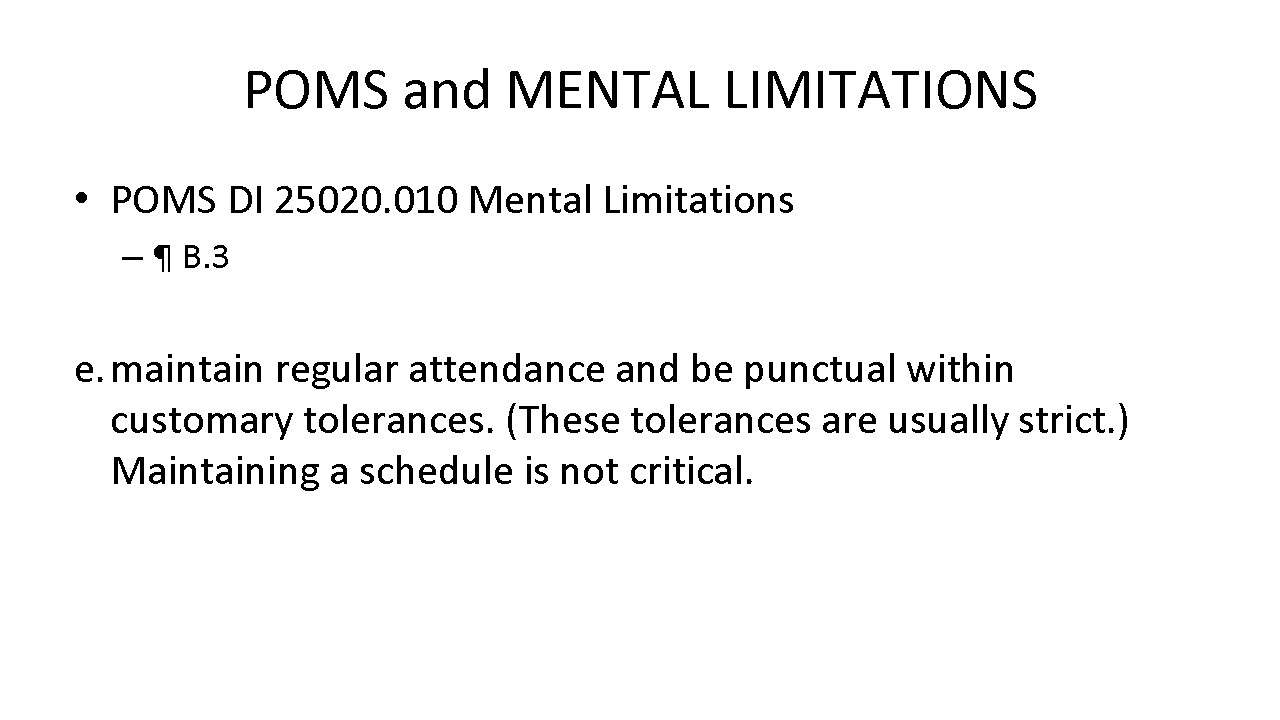
Accepting a small part of the psych CE and pushing the limitation way down equals no jobs.  The lesson is when a limitation is potentially overstated, understate it in such a way that the answer is still no jobs.  See POMS DI 25020.010 for Mental Limitations for the critical requirements of unskilled work. 

Tuesday, March 19, 2019

Responding to the Five-Day Rule When the ALJ Refuses Post-Hearing Development

The vocational expert coughs up testimony that is frankly not true.  We ask for post-hearing development.  The ALJ says "no, the five-day rule gives me discretion to refuse, and I do."  The question is whether the ALJ has a regulatory leg to stand on.  Secs. 404.935 and 416.1435 provide in relevant part:
(a) When you submit your request for hearing, you should also submit information or evidence as required by § 404.1512 [§ 416.912] or any summary of the evidence to the administrative law judge. Each party must make every effort to ensure that the administrative law judge receives all of the evidence and must inform us about or submit any written evidence, as required in § 404.1512 [§ 416.912], no later than 5 business days before the date of the scheduled hearing. If you do not comply with this requirement, the administrative law judge may decline to consider or obtain the evidence, unless the circumstances described in paragraph (b) of this section apply.
 Secs. 404.1512 and 416.912 describe the evidence that claimant must submit or inform the agency no later than five business days before the hearing:
(a) Your responsibility—(1) General. In general, you have to prove to us that you are blind or disabled. You must inform us about or submit all evidence known to you that relates to whether or not you are blind or disabled (see § 404.1513 [§ 416.913]). This duty is ongoing and requires you to disclose any additional related evidence about which you become aware. This duty applies at each level of the administrative review process, including the Appeals Council level if the evidence relates to the period on or before the date of the administrative law judge hearing decision. We will consider only impairment(s) you say you have or about which we receive evidence. When you submit evidence received from another source, you must submit that evidence in its entirety, unless you previously submitted the same evidence to us or we instruct you otherwise. If we ask you, you must inform us about:
(i) Your medical source(s);
(ii) Your age;
(iii) Your education and training;
(iv) Your work experience;
(v) Your daily activities both before and after the date you say that you became disabled;
(vi) Your efforts to work; and
(vii) Any other factors showing how your impairment(s) affects your ability to work, or, if you are a child, your functioning. In §§ 404.1560 through 404.1569 [§§ 416.960 through 416.969], we discuss in more detail the evidence we need when we consider vocational factors.
 Evidence about other work in the national economy or how work is typically performed in the national economy are absent from the list.  Rebutting vocational expert testimony is not subject to the five-day rule.

The content of vocational expert testimony is always a surprise.  Sometimes it is a good surprise and sometimes not.  But surprise adverse testimony provides a basis for requesting a supplemental hearing under HALLEX I-2-6-80:
Circumstances may require an ALJ to adjourn a hearing in progress and continue it at a later date, conduct a supplemental hearing, or reopen the record to receive additional evidence. If testimony at a hearing leaves unanswered questions, the ALJ may supplement the hearing record with additional oral testimony, a deposition, or additional documentary evidence.
A continuance or supplemental hearing is appropriate when:
  • certain testimony or a document adduced at the hearing has taken the claimant by surprise, is adverse to the claimant's interest, and presents evidence that the claimant could not reasonably have anticipated and to which the claimant is not prepared to respond;
[...] 
If the ALJ decides during the course of a hearing to continue the hearing and hold a supplemental hearing at a later date, the ALJ may set the date for the supplemental hearing at that time or state that he or she will notify the claimant later of the date of the supplemental hearing. The rules governing the conduct of the initial hearing apply to the continued or supplemental hearing. If an ALJ decides to conduct a supplemental hearing, he or she must reopen the record.
Unless the claimant or representative had ex parte communication with the vocational expert before the hearing or the ALJ proffered responses to written interrogatories before the hearing, the vocational expert testimony is always a surprise.  If it is adverse, post hearing development is appropriate if not a full supplemental hearing.

Tuesday, March 5, 2019

A Truly Vile Tactic - Changing the Hypothetical During Cross-Examination

An ALJ that has a pay rate over 50% in West Los Angeles has a hearing on remand from the District Court via another ALJ hearing and this time an Appeals Council remand.  Most recently vacated ALJ decision is medium, six hours of standing/walking; six hours of sitting; occasional contact with coworkers; no public; and limited to one and two-step tasks.  On remand, the ALJ limits the claimant to that set except changes the one and two-step tasks to able to perform reasoning level 1 and 2 work.  Vocational expert identifies work:
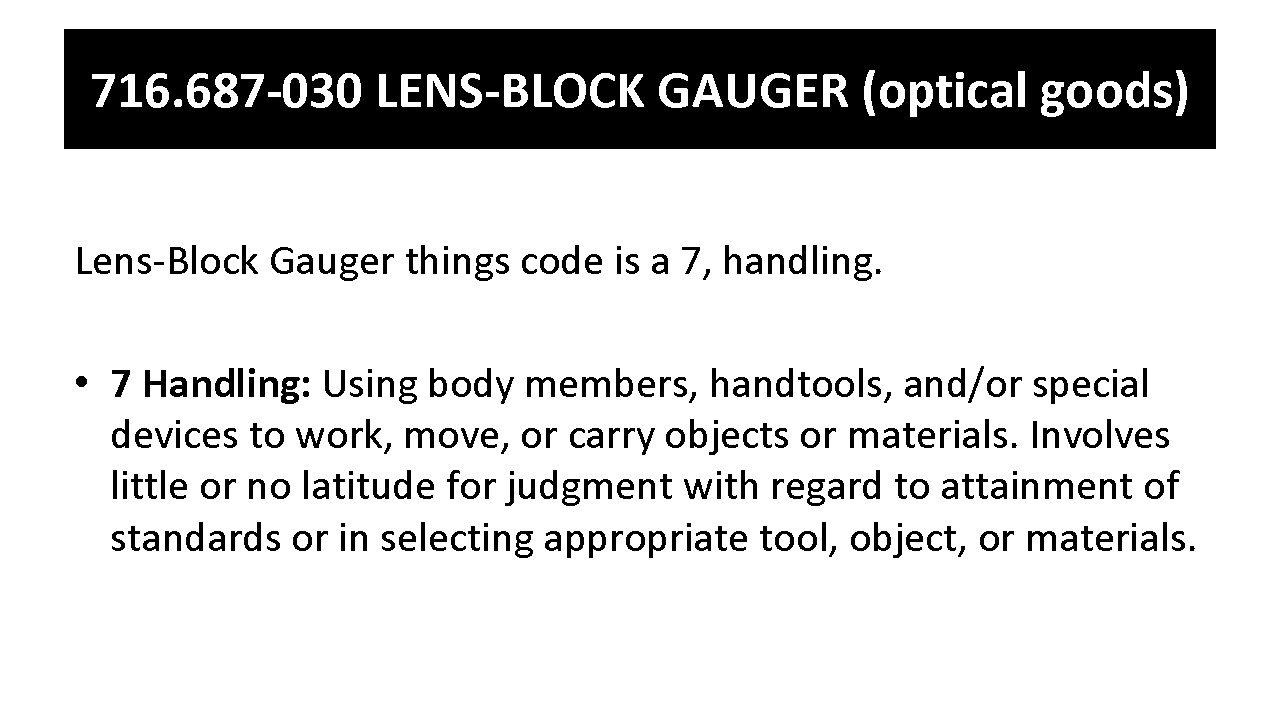
  1. PACKAGER, MACHINE - DOT 920.685-078
  2. CONVEYOR FEEDER-OFFBEARER - 921.686-014
  3. CLEANER, LABORATORY EQUIPMENT - 381.687-022
Cross focuses first on the ability to perform these occupations while standing/walking not more than six hours in a workday.  After first claiming that the DOT permits six hours, the VE backs down on the challenge that the DOT Appendix C says nothing about standing/walking.  Vocational expert concedes on machine packager and starts down that path with feeder-offbearer.  ALJ interrupts and asks if six hours of standing-walking eliminates all three occupations.  

"Yes."  

ALJ changes the question to assume eight hours of standing/walking.  Cross continues to confirm that medium work requires more than six hours as a general proposition.  Need to lock that down and did.  

Cross turns to occasional contact with coworkers and supervisors.  Making an offer of proof based on O*NET OnLine ver. 23.2, the VE states that she relies on her experience.  

"Who has the greater ability to gather data and report data, you or the Department of Labor?"

"Does DOL abide by OMB standards for reporting data?"

"Who peer reviews your data and conclusions?"  

The ALJ deletes the occasional contact with others from her hypothetical.  

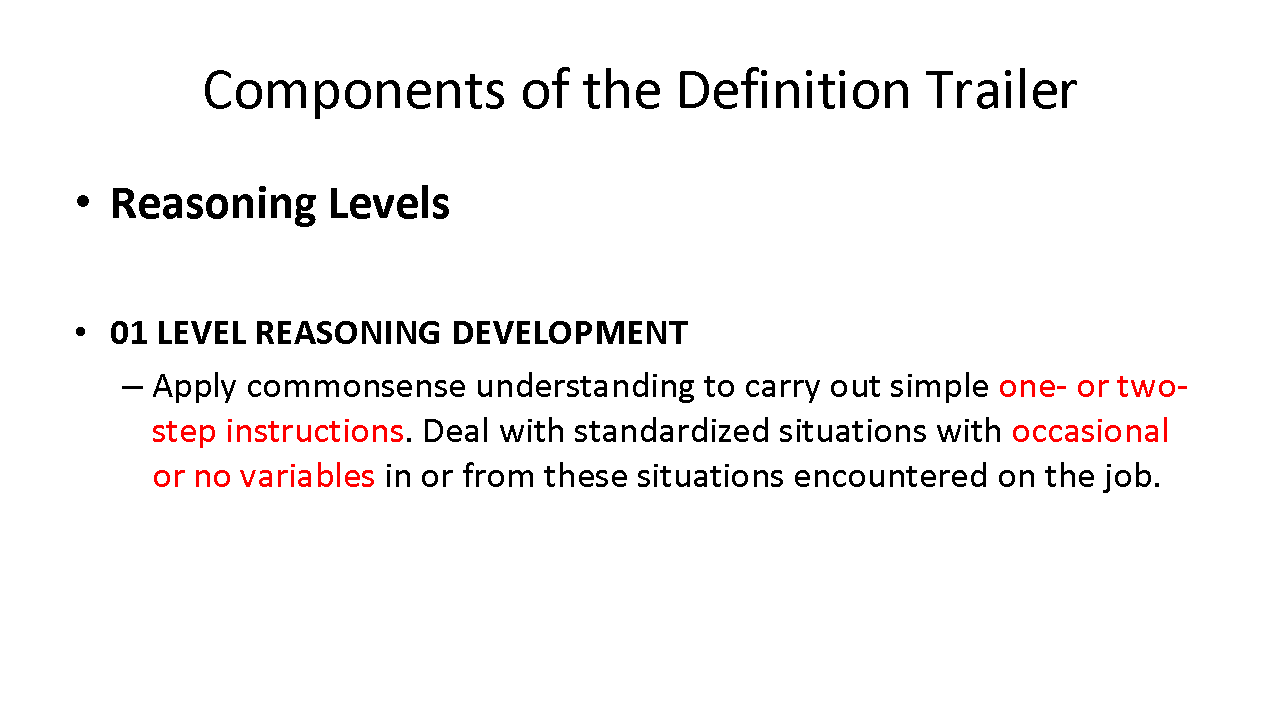
Cross turns to reasoning level 1.  The ALJ reminds everyone that the hypothetical question assumed reasoning levels 1 and 2.  None of the jobs have reasoning level 1.  

The opinion evidence shows limited capacity to accept criticism from supervisors.  Assuming an inappropriate response to criticism one a week to once a month, can that person sustain work?  

"No."  

Wear down the witness.  Make the ALJ display the intent to deny by changing the hypothetical questions.  And then reach for the jugular.  A pattern of one a week to once a month of inappropriate responses to criticism is fatal to the world of unskilled work.  

Tuesday, October 16, 2018

I Object to the Vocational Expert's Testimony -- Overruled

The vocational expert responds to a hypothetical question that assumes a limited education, unskilled work experience, limited to sedentary work with occasional superficial contact with coworkers and supervisors.  The vocational expert trots out the usual suspects of occupations aggregating to a million jobs because if you don't want to have to think, well 300,000 here, 200,000 there, and 500,000 in the last one just makes it easy and what the hell, the ALJ doesn't care and 95% of the representatives out there don't know enough to make a peep.  A million jobs  The 48-year old claimant loses.  But you happen to be in the 5%.

1.  Objection, the vocational expert doesn't have training in numbers of jobs.

That objection belongs before the vocational expert testified, not after.  And the truth of the matter is that vocational experts perform labor market surveys and look at employment numbers.  They know more than the public about work.  Their opinion is probative even under the inapplicable strict standards of evidence in court.  Objection overruled.

2.  Objection, the vocational expert testimony lacks foundation, has no support, is unreliable, and pulled out of thin air.

None of those are objections to the admissibility of evidence.  Those are arguments as to weight.  If the vocational expert's testimony is a feather and no evidence exists to counter the vocational expert testimony, the feather outweighs the vacuum by a factor of infinite progression.  That doesn't mean that the ALJ will accept uncontradicted evidence from an agency selected expert.   But the ALJ probably will.  Objection overruled.

3.  Objection, the vocational expert's testimony identifies work that is no longer unskilled or no longer exists.

This is a variation of objection #2.  It does not go to admissibility, it goes to weight.  Present some evidence that weighs more.

4.  Objection, the vocational expert's testimony assumes an accommodation with a sit-stand option.

Now that is an objection because agency policy does not permit consideration of an accommodation in making the assessment at step five of the sequential evaluation process.  SSR 00-1c.  The truth of the matter is that some work permits a sit-stand option as the work exists in the national economy.  Security guards is an example:


Series ID: ORUP1000000000000139
Not seasonally adjusted
Series Title: % of all workers; sitting vs. standing/walking at will is allowed
Requirement: Physical Demands
Occupation: all workers
Estimate: sitting vs. standing/walking at will is allowed
YearPeriodEstimate
2017Annual37.4

But the ORS does not list any discernible group that contains unskilled work as having that sitting versus standing/walking at will data field.  The absence of data should be read as not allowed not license to make things up.  SSA recognizes that unskilled work requires maintaining body posture to maintain productivity.  SSR 83-12

These examples make clear that there is generally not an objection to the vocational expert testimony.  Admissibility is a low bar.  Weight is the correct focus.  Arguing weight requires that the claimant present additional evidence.  Setting that stage requires a set of preliminary questions:

1.  Is your testimony with the data published by the Department of Labor?
a. The Occupational Outlook Handbook
b. The Occupational Information Network
c. The employment projections
d. The occupational employment statistics
e. The current population survey 
2.  Is your testimony consistent with the the data published by the Census Bureau?
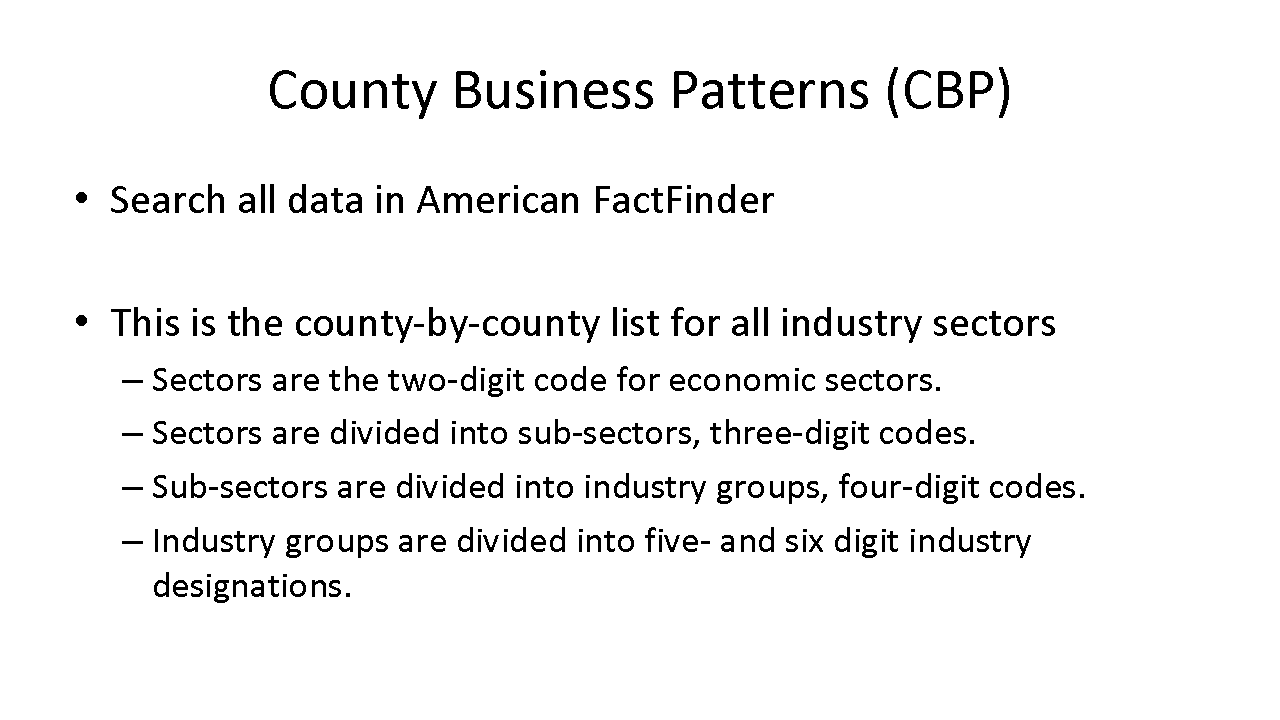
a. County Business Patterns
3.  Is your testimony consistent with the DOT industry designations?

4.  Is your testimony consistent with the data fields not contained in the printed SCO but published in the electronic versions of the DOT/SCO (Job Browser Pro, West Law, etc.)?

The response from the ALJ or the vocational expert that the witness relies on experience is this:

5.  How does your experience as a rehabilitation consultant compare to the data gathering capacity and reporting of the Department of Labor or the Census Bureau?

The best tactic is to avoid the use of the "objection."  It is not the right procedure.  The only procedure that has a chance of winning is the introduction of new evidence and then the demand tha that the ALJ resolve the conflict in the evidence.  See question 5:  how does the VE's local and anecdotal experience compare to the statistical prowess of the Department of Labor and the Bureau of Labor Statistics?  They are not in the same league. 


Thursday, August 16, 2018

Progress and Pushing Vocational Experts to Reasonable Answers

A court remand case with the prior residual functional capacity finding:
After careful consideration of the entire record, I fmd that the claimant has the
residual functional capacity to perform a range of light work as defined in 20 CFR
404.1567(b) and 416.967(b). Specifically the claimant is able to lift pounds occasionally and 10 pounds frequently.  He can stand and/or walk for two hours out of an eight-hour day, with the ability to use a cane when ambulating outside of the work area; he can sit for 6 hours of an 8 hour day, but must have the ability to stand and stretch every hour estimated to take 1 to 3 minutes per hour.  He does not need to leave the work station to do the stretching.  He can occasionally bend, stoop, and crouch, but he cannot crawl or kneel. He cannot work at highly fast-paced work, such as rapid assembly line work, nor work requiring public contact- He can perform low stress jobs which is defined as jobs having occasional decision making or occasional changes in the work setting.
We have a younger individual with a limited education and unable to perform past work and lacks transferable skills.  The vocational expert is testifying today between two different ALJs so we have some time waiting for the VE.  ALJ asks me how I am going to get this claimant below sedentary.  I don't think I have to, this residual functional capacity will not permit work in significant numbers.  

Enter the vocational expert.  ALJ asks the VE to assume a person of any age, with any education, and any work history with the previously assessed residual functional capacity.  Vocational pauses, contemplates, and then answers, "no jobs."  

I have been in hearings with this judge and this witness many times before.  We all know that identifying some production job will focus on work pace; clerical positions will focus on changes and decision-making; all the counter clerk-type jobs are out for no public contact; and we have a total of four breaks totaling 12 minutes in addition to the California-mandated two 10-minute breaks and 30-minute meal break.  The VE focused on the realistic limitation to sedentary work; the elimination of light work because of a cane outside of the work station; the unavailability of production jobs; and the limitation to occasional decisions and changes.  "No jobs."  

This is not a VE that typically testifies "favorably" to claimants, but he isn't hostile to them either.  My post mortem analysis is that the history with this VE nudged him to the testimony and my history with the ALJ made him more likely to accept the testimony and explanation.  

"Any questions, counsel?"

Smile, "no questions, Judge."  

"Hearing adjourned, have a nice day."  


Saturday, June 2, 2018

Interaction with Supervisors and Coworkers -- Qualitative versus Quantitative

Anxiety disorder, depressive disorder, the list goes on.  The etiology matters far less than the limitation posed.  We typically see an occasional contact with coworkers and supervisors and either no contact or occasional contact with the public.  That quantitative analysis (occasional) ignores the qualitative aspect that we sometimes see in a variation of superficial

The O*NET describes Communicating with Supervisors, Peers, or Subordinates.  Of the 3,100 unskilled occupations, Farmworkers and Laborers, Crop has the lowest Importance ranking, 39.  That score falls at the very top of the somewhat importance ranking.  The O*NET suppresses the result on the Level scale.  Cutters and Trimmers, Hand is next on the list of having low importance for communicating with supervisors and coworkers, a score of 42, important.  The Level report scores a 45, more than double the level anchor of writing a brief not to other and relatively close to reporting of a sales meeting to a supervisor. 

Those are the lowest scores for unskilled work.  Every other communicating with supervisors and co-workers is higher.  Qualitatively, the world of work requires getting a passing grade in "plays well with others."  The agency knows this.  POMS DI 25020.010 reports that critical requirements of work include:
g.  work in coordination with or proximity to others without being (unduly) distracted by them.
j.   ask simple questions or request assistance.
k.  accept instructions and respond appropriately to criticism from supervisors.
l.  get along with coworkers or peers without (unduly) distracting them or exhibiting behavioral extremes.
These are some of the Mental Abilities Critical for Performing Unskilled Work.  These activities do not depend on periodicity, they depend on getting a passing grade in "plays well with others."  It isn't occasional, it is whether the claimant can perform those four activities on-demand, when the work environment requires it.  We have discussed the minimal or superficial contact problem as well as methods for cross-examining vocational experts.  

We must focus on qualitative not just quantitative aspects of workplace function.  

Tuesday, May 1, 2018

Keeping the Theory of the Case in Mind During VE Cross

A claimant has a hearing.  She is 57, high school plus education, and a skilled background performing work as a court clerk (DOT 243.362-010).  She worked in covered employment. 

ALJ asks the vocational expert to assume that vocational background and a limitation to sedentary work with occasional use of the right dominant hand for gross and fine manipulation.  The SCO classifies the occupation as requiring occasional reaching, handling, and fingering.  At this point, the case is looking at a step 4 denial -- the claimant can return to her past relevant work.  The VE testifies to that. 

The record contains a good medical source statement.  That statement describes the claimant as able to use the right hand minimally.  The claimant had multiple surgeries on the hand and wrist which developed into reflex sympathetic dystrophy or regional pain syndrome.  This is a solid opinion based on good objective findings.  The representative asked the VE to assume less than occasional  of the right hand. 

This is a bad question.  We should use the MSS words whenever possible.  When we translate medical source opinions because we are trained not to plagiarize, we play the telephone game.  The meaning gets lost because less than occasional means something different than minimal.  If we think that minimal is ambiguous, we can offer a reasonable explanation.  Minimal does not mean zero.

Minimal implies less than the full range of occasional.  The SCO defines occasionally as up to a third of the time.  It includes one.  In the world of physical activity, we cannot use negative numbers so there is literally no less than occasional.  What does minimal mean in these circumstances?  We should offer definitions that fit the facts of the case and the context of the doctor's report -- we could offer the definition of rarely, or quantify it to the lower half of the occasional range, 0-16% of the day

The VE responds to the bad question with a response that eliminates the past relevant work.  The representative asked if other work was available.  STOP.  We have an obligation to represent the claimant, not sustain the Commissioner's burden of proof.  We should not ask that question -- unless we know that the answer is none

The VE responds with our favorite sedentary unskilled occupation, surveillance systems monitor. The SCO describes SSM as having no reaching, handling, and fingering.   The representative then proceeded to ask questions about the incidence of this occupation and whether it had changed.  STOP.  This claimant grids out under rule 201.06.  We do not want to confuse the record, the ALJ, or a reviewing court with a colloquy about SSM and whether it exists in significant numbers and whether the occupation had changed.  We must keep the theory of the case in mind and know the structure of the grids. 

It is that last question that forms the heart of consternation.  Had the occupation of SSM changed since the date last update?  Change that question to: has the occupation of court clerk changed since the date last updated in 1977?  Those are computer-based jobs.  Ask that question.  The ALJ in this case asked a question that leads to a step four denial; rip that concept to shreds. 

Another tact appears.  The court clerk occupation requires average motor coordination, finger dexterity, and manual dexterity per the SCO.  Ask that question, assume a person that has below average dexterity or can tolerate minimal dexterity demands, can that person perform the work of a court clerk either as actually performed or as generally performed? 

Dexterity is rated in the SCO electronic files.  It is listed in WestLaw for each DOT code as well as the SOS Manual from US Publishing and the products from SkillTran.  Dexterity is an SCO component.  Dexterity is part of the agency's regulatory consideration of work. 

The representative gets a point for reading the treating doctor's MSS.  He loses a point for using an inappropriate definition of the words used by the doctor; loses another point for asking about other work; loses another point for chasing the unskilled sedentary occupation down the rabbit-hole; and loses five points for failing to chase the nature of the past work up the tree.  The representative failed the claimant and now the case is in federal court.  We have to do better. 

Friday, November 3, 2017

Using Objective Findings as a Basis for Cross-Examination

"Counsel, you must frame your questions in vocationally relevant terms."

If a representative has cross-examined vocational experts, the representative has heard that admonition from the ALJ.  Sometimes it is just a bully tactic; sometimes it is because the representative is not asking questions that lead to useful information or are hopelessly vague.  Use of objective findings can provide a useful basis for extending the cross-examination into areas that lead to opinion testimony of no jobs. 

The client testifies to limited ability to bend and stoop.  The consultative examiner finds 45 degrees of forward flexion and opines that the claimant can occasionally bend and stoop.  The state agency doctor parrots the CE -- the claimant can occasionally bend and stoop.  The treating physician does not address the question.  Occasional stooping does not significantly impact the ability to perform light or sedentary work.  Social Security Ruling 85-15; Social Security Ruling 83-10.  Is the claimant toast or can the representative do more? 

Tiengo pregunta ... I have a question:
If we assume the same person described in the ALJ's first hypothetical question -- do you need me to repeat that question for you, no, ok -- and add to that question that while the person can occasionally bend and stoop, the person can never bend or stoop beyond 45 degrees.  That means the person cannot bend or stoop enough to even put their hands below their knees.  Can that person perform any of the work that you described here today?  
The same mantra applies to limited flexion of the neck.  In my experience 25 degrees -- half the range of motion in the neck -- will wipe out the ability to perform unskilled production and clerical work. 
If we assume the same person described in the ALJ's first hypothetical question -- do you need me to repeat that question for you, no, ok -- and add to that question that while the person can occasionally bend and stoop, the person can never bend the neck beyond 25 degrees.  That means the person cannot look straight down; he/she has lost half of the ability to look down and can only flex the head and neck down to 25 degrees occasionally during the day.  Can that person perform any of the work that you described here today?  
When a representative doesn't know how to frame a question, the representative should resort to reciting the objective findings contained in the medical evidence.  If the ALJ starts the "vocationally relevant terms," the representative must back up and ask the vocational expert:
As part of your education, training, and experience, did you study ergonomics?
Did that study of ergonomics include consideration of the frequency but also the amount of body motion required to perform job duties as essential job functions? 
Did that study of ergonomics include consideration of the frequency but also the amount of body motion required to perform job duties as bona fide occupational qualifications - how the job is typically performed?
If I ask you to assume not only a frequency but also a specific amount of motion in a particular joint(s) of the body, is that relevant to your education, training, and experience?
If the answer to those questions is "no," the VE isn't qualified and move to strike all testimony.  If the answer to those questions is "yes," ask the limited motion question again whether that question involves the back, neck, wrist, elbow, or other joint of the body.  I have not had an ALJ challenge this line of questioning ... yet. 


Friday, October 13, 2017

Changing the Dialogue from Off-Task to Consequence of Error

A lot of representatives ask the generally worthless question: assuming the person is off task 20% of that day, can that person work?  I can't really blame them, a lot of ALJ's ask the same throw away question as a placebo to the claimant.  The question is rarely quantified or supported in the record in any meaningful manner.  But what we want to do is ask a question where we can get some data.

Data is the bane of the vocational expert's existence.  Data robs vocational experts of discretion.  Data strips out the ability of the wayward vocational expert from making stuff up.  We have data from the O*NET OnLine that addresses Consequence of Error.

First, develop the record about mistakes.  This could come in the form of serial 7's or 3's, inability to recall items, or other items from a mental status examination.  Developing the record from the claimant or a third party about mistakes made in activities of daily living will assist the quest.  And then start in on the vocational expert in cross-examination.
How important is accuracy in the occupations identified?
Does there exist any data about the consequences of error in the occupations identified? 
There are data and we have a mission.
 If we assume that the person identified in ALJ hypothetical question #1 made mistakes in the work functions 10% of the workday, would that person be subject to progressive discipline and eventually fired?  
I prefer a minimalist approach so I ratchet that question down.
Assume that person made one mistake per day, every day, that the employer could not remedy immediately.  Would that person be subject to progressive discipline and eventually fired?  Once per week, every week, week in and week out.  Same question.  
What does the data show?  One of larger groups of occupations is helpers, production workers, SOC 51-9198.  The Occupational Outlook Handbook, in data for occupations not covered in detail, describes the work:


  • 2014 employment: 419,200
  • May 2016 median annual wage: $24,830
  • Projected employment change, 2014–24:
    • Number of new jobs: -16,100
    • Growth rate: -4 percent (Decline)
  • Education and training:
    • Typical entry-level education: No formal educational credential
    • Work experience in a related occupation: None
    • Typical on-the-job training: Short-term on-the-job training
  • O*NET:
  •  Note the link to the O*NET OnLine.  We go there.  Running a custom report for work context and scrolling down (CTRL-F error - faster!), we find:

    53 
    Consequence of Error — How serious would the result usually be if the worker made a mistake that was not readily correctable?
    18     Extremely serious
    24     Very serious
    27     Serious
    15     Fairly serious
    16     Not serious at all
    It looks like 84% of jobs have at least fairly serious consequences for the first mistake.  Most of occupations (69%) have a greater degree of consequence of error rating (serious to extremely serious).
    Assuming that the Employment Training Administration and the Department of Labor have published reliable governmental data, could the person that isn't just off task but makes mistakes that cannot be readily corrected on a chronic basis, just once a week, keep this kind of job?
    The answer is, "No."   Drop the off-task mantra and focus on consequence of error.


    Thursday, October 12, 2017

    Cross-Examination on Occasional Contact with Supervisors

    A fairly common limitation for a claimant with moderate impairments in social functioning -- assume that the person can tolerate up to occasional contact with supervisors.  This limitation does not preclude the vast majority of jobs.  As the great Scott Elkind has been heard to say, "If I think about you when I wake up three times and we are not sleeping together, you are fired."  Workers, especially unskilled workers, should not need ongoing and direct supervision more than the lower range of occasionally.  The limitation is an illusion with the appearance of consideration of the impairment without ever impacting the world of unskilled work.

    Or so it would seem.  There does exist a period of time when an employee needs and must have more than occasional supervision -- during the first 30 days of training.  That fact constitutes a barrier to employment.  The line of inquiry focuses on whether the claimant can overcome that barrier with the limitation posed in the hypothetical question.
    Assume that the person cannot tolerate more than occasional contact with supervisors and coworkers in the first 30 days of employment -- during orientation, training, and gaining proficiency in performing the work function.  Can that person perform the jobs identified here today?
    The answer from the vocational expert should be, "No."  An employee performing work never before performed must have the ability to tolerate more than occasional contact with supervisors and other personnel training that new employee.  The economic barrier of entry into the marketplace of unskilled work is that training period, up to 30 days, of regular and ongoing contact with supervisors.

    The other angle worth pursuing focuses on the other two-thirds of the day.  A claimant that can tolerate occasional contact with supervisors cannot tolerate contact with supervisors frequently during the day.
    Assume that the person will frequently not be able to accept instruction or respond appropriately to criticism from supervisors.  Can that person perform the jobs identified here today?
    The answer is, "No."  Taking the minimalist approach:
    Assume that the person is rarely reacts inappropriately to supervisors, once or twice per month.  Would that person be subjected to progressive discipline and eventually terminated?
    The answer to that question is, "Yes."

    Focusing on the first 30 days of training or the long-term effects of a social impairment, the inability to get trained and the inability to respond appropriately to criticism from supervisors will lead to termination.  The person cannot sustain substantial gainful activity. 

    See also POMS DI 25020.010 Mental Limitations.  Paragraph B.3 lists the functions critical to performing unskilled work.  

    Thursday, October 5, 2017

    Finger Dexterity -- Examples of Average Dexterity -- How to Develop the Evidence

    Earlier this week we looked at the descriptions of finger and manual dexterity as rated vocationally relevant factors described in the Revised Handbook for Analyzing Jobs.  Average, even with the definition of statement of 34th to 67th percentile, lacks clarity.  No matter, the RHAJ gives examples of average finger dexterity, Level 3.  Three of the eight examples have correlation to everyday activities.  
    F-3:1 Feeds tungsten filament wire coils into machine that mounts them to sterns in electric light bulb:
    Finger dexterity is required to grasp coils with tweezers and insert them into slotted plate of mounting machine; and to pick up and examine finished mounts as they emerge from machine.
    Ask the claimant about the ability to use tweezers.  
     F-3:2 Takes dictation in shorthand and transcribes dictated materials, using typewriter:
    Finger dexterity is required in forming shorthand symbols with pencil or pen and in depressing keys of typewriter.
    Ask the claimant about the ability to write quickly with a pen or pencil on a pad of paper.  
     F-3:4 Cuts and styles hair, using clippers, comb, and scissors, and performs other personal services for patrons of barber shop:
    Controlled movement of fingers is required to use clippers, scissors, and other barber tools when cutting and shaping hair.
    Ask the claimant about the ability to use scissors.  

    If the claimant cannot use tweezers, write a note quickly, or use a pair of scissors to cut on a line, then the person cannot perform activities that require average finger dexterity.  The evidence fits well within the defined vocational criteria and permits the examination of vocational expert that assumes below average dexterity.

    Monday, October 2, 2017

    Aptitudes and the DOT codes

    Appearing at a hearing in Seattle in front of a judge that doesn't know how many bags of tricks I carry with me.  Claimant has manipulative problems, describes herself as clumsy and the medical/therapy records bear out the lack of dexterity.  The ALJ wants to quantify the impairment in terms of occasional and frequent fine and gross manipulation (fingering and handling).  That doesn't cut it for this case because those terms do not qualitatively describe the problem.

    The Department of Labor released the Handbook for Analyzing Jobs and accidentally omitted chapter 9 -- aptitudes.  These 36 pages appear in the Revised Handbook for Analyzing Jobs.
    Aptitudes, a component of Worker Characteristics, are the capacities or specific abilities which an individual must have in order to learn to perform a given work activity. There are 11 Aptitudes used by USES for job analysis.
    The aptitudes are:
    G - General Learning Ability
    V - Verbal Aptitude
    N - Numerical Aptitude
    S - Spatial Aptitude
    P - Fonn Perception
    Q - Clerical Perception
    K - Motor Coordination
    F - Finger Dexterity
    M - Manual Dexterity
    E - Eye-Hand-Foot Coordination
    C - Color Discrimination
    Unlike other rating scales used in the DOT and its companions, the aptitudes use 1 as the highest level of function and 5 as the lowest:
    1. The top 10 percent of the population. This segment of the population possesses an extremely high degree of the aptitude.
    2. The highest third exclusive of the top 10 percent of the population. This segment of the population possesses an above average or high degree of the aptitude.
    3. The middle third of the population. This segment of the population possesses a medium degree of the aptitude ranging from slightly below to slightly above average.
    4. The lowest third exclusive of the bottom 10 percent of the population. This segment of the population possesses a below average or low degree of the aptitude.
    5. The lowest 10 percent of the population. This segment of the population possesses a negligible degree of the aptitude.
    We are concerned about our claimant with a manipulative problem with Finger Dexterity and Manual Dexterity.
    F - FINGER DEXTERITY: The ability to move the fingers and manipul. small objects with the fingers rapidly or accurately.
    M - MANUAL DEXTERITY: The ability to move the hands easily and skillfully Ability to work with the hands in placing and turning motions.
    The RHAJ gives examples of what average (level 3) means for these and other aptitudes.  So please Judge, don't tell me to use vocationally relevant terms in my cross until you have read the statistics and the taxonomy set forth in the RHAJ.  The aptitudes for each occupation -- we find them in every professional regurgitation of the DOT and its companions, i.e. West and SkillTran.  When I ask the vocational expert to assume below average dexterity, I am referring to the use of those rated and defined terms in the RHAJ and the descriptions of each occupation found in West and the various SkillTran products.

    Drop the mic ... walk away.