Showing posts with label Occupational Employment Quarterly. Show all posts

Thursday, July 30, 2020

Postmortem on Goode v. Commissioner -- the Court Got Half the Story

The Eleventh Circuit reversed in a huge win for claimants on the reliability of vocational expert testimony. Goode v. Commissioner of Soc. Sec. The court called out the vocational expert and ALJ (but neither by name). Goode v. Berryhill. The decisions are a good read and available to everyone to read for themselves. Today we pull back the curtain to disccover that the vocational expert was reckless, tried to cover his tracks, and I think I know why. 

We start with the district court decision:
Plaintiff notes that the VE testified that he got these job numbers from the Occupational Employment Quarterly ("OES), which does not provide job numbers by Dictionary of Occupational Title numbers, but by Specific Occupational Code (SOC) group. (Doc. 22 p. 8).
We continue with the circuit court decision: 
the vocational expert must look to other sources like the Occupational Employment Quarterly (OEQ), which is compiled by a private organization called U.S. Publishing, to find employment statistics. See Herrmann v. Colvin, 772 F.3d 1110, 1113 (7th Cir. 2014); Brault v. Soc. Sec. Adm., 683 F.3d 443, 446 (2d Cir. 2012). The OEQ database, however, does not compile data by DOT codes, but rather through the Standard Occupational Classification (SOC) system. See Brault, 683 F.3d at 446; Occupational Employment Statistics, Bureau of Labor Statistics, https://www.bls.gov/oes/ (last visited April 30, 2020).
Both courts reference the OEQ.  Neither quotes the VE referencing the OEQ.  

Assuming that the VE did rely on the OEQ to identify bakery worker (bakery worker, conveyor line) as belonging to SOC 51-3099, there is a huge problem for the veracity of the VE.  In no publication of OEQ has US Publishing ever listed food processing workers, all other (SOC 51-3099) as an occupational group.  Why would the OEQ omit SOC 51-3099?  As Goode argued successfully to the circuit court, the Department of Labor does not assign any DOT codes to SOC 51-3099, none.  

The question has to turn to the VE's source for the idea that bakery workers belong in SOC 51-3099.  That honor belongs exclusively to Job Browser Pro.  JBP does list bakery worker, conveyor line (DOT 524.687-022) as belonging to SOC 51-3099.  JBP did so in 2014 and does so today.  Why not confess to use of JBP as the source for the job numbers?  As the circuit court found, the VE aggregated the occupational group identifying all the jobs in the group, not just bakery worker.  JBP states now and in 2014 that bakery worker, conveyor line represents fewer than 500 jobs.

Goode argued and the circuit court found that bakery worker belongs to production workers, all other (SOC 51-9199).  For the 2010 SOC, that is true.  Bakery worker is one of 1,590 DOT codes and one of 405 light unskilled DOT codes that belong to production workers, all other.  None of those occupations represent 43,000 jobs in the nation.  

One final point for the day is warranted.  Labor lists the titles of occupations that belong to food processing workers, all other (SOC 51-3099).  They are:
  1. Olive Pitter
  2. Pasta Press Operator
  3. Poultry Hanger
  4. Yeast Maker
The VE did not honestly identify the source for his testimony.  If the VE did, it would have been easy to check the job numbers against the source to prove them wrong.  But the VE corps needs to please the ALJ to remain on the rotation.  Not identifying significant numbers of jobs will lead to removal from the rotation.  The VE and ALJ got slammed in this case but their deceit rests just below the surface.  

_______________________________________________________

Suggested Citation:

Lawrence Rohlfing, Post Mortem on Goode v. Commissioner -- the Court Got Half the Story, California Social Security Attorney (July 30,  2020) edited (Aug. 18, 2020)

Monday, July 1, 2019

Why OccuCollect Provides a More Reliable Job Number Estimate -- A Cascading of Occupational Attributes

The nature of work has changed since the Dictionary of Occupational Titles was last published in 1991 and certainly changed since 10,000 of the 13,000 DOT codes were last updated in 1977.  Occupations have become obsolete; new occupations emerged; and other occupations morphed into something new.  When we look at an occupation and ascertain its job numbers, we typically examine gross job numbers (Occupational Outlook Handbook, Employment Projections, and Occupational Employment Statistics) and then whittle that number down using industry (Employment Projections, and Occupational Employment Statistics).  Once we get that that density model of occupational groups existing within specific industries, the trick requires an estimation of the number of jobs attributable to different occupations at that occupation-industry intersection.  The Occupational Employment Quarterly uses equal distribution at the occupational level.  Job Browser Pro uses equal distribution at the occupation-industry intersection.

OccuCollect uses a different methodology.  OccuCollect examines the gross number of jobs within the occupational group and then uses either the Occupational Requirements Survey or the O*NET Resource Center report of education, training, and experience to ascertain the number of unskilled jobs within the group.  Cascading the work requirements on the Specific Vocational Preparation separates the jobs by strength, sitting, standing, walking, or manipulation ... for example.  For the cognitive-emotional requirements of work, the O*NET Work Context reports work best for establishing the amount of contact with others, interaction with the public, dealing with conflict, and the need for teamwork ... for example.

Job Browser Pro and the Occupational Employment Quarterly assume the presence of unskilled work or the presence of light work based on the number of DOT codes counted.  That method assumes a fact without evidence.  Better to use the estimates of the percentage of jobs that represent unskilled and light work from the survey of the economy conducted by the Department of Labor.

See When to Use Occu Collect.

Sunday, May 26, 2019

Electrical and Electronic Equipment Assemblers -- Post Biestek Analysis -- Part 1

We are in the post-Biestek era.  The record must show conflict.  That poses the obligation on the ALJ to resolve that conflict.  Unrebutted testimony is substantial evidence.  Today, we start the process of understanding Electrical and Electronic Equipment Assemblers (SOC 51-2022) (equipment assemblers).  In this piece, we survey the Dictionary of Occupational Titles, Occupational Outlook Handbook, Occupational Employment Quarterly, and Job Browser Pro.

We start this process with the survey of the DOT. Equipment assemblers contains 61 DOT codes.
Sedentary: 3 occupations, 1 unskilled
Light: 39 occupations, 10 unskilled
Medium: 16 occupations, 1 unskilled
Heavy: 3 occupations, 0 unskilled
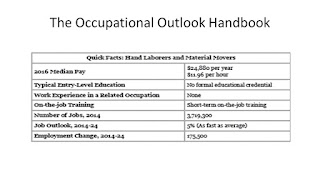
Still looking for the broad overview, we turn to the Occupational Outlook Handbook.  The OccuCollect OOH report states:

51-2022 Electrical and electronic equipment assemblers

Typical Education Needed, 
High school diploma or equivalent
Work Experience in a Related Occupation
None
Typical On-The-Job Training Needed to Attain Competency
Moderate-term on-the-job training
2016 Employment
218,900

The typical requirements are a high school or equivalent education, no prior work experience, and are either semi-skilled or skilled.  Equipment assemblers represent 218,900 jobs.  Most of them require education and training that precludes identification by a vocational expert as target work at step 5 of the sequential evaluation process.  .

A gross equal distribution method would lead a vocational expert to identify 3,600 sedentary jobs and 35,900 light jobs.  The equal distribution method crumbles with cross-examination and the submission of rebuttal evidence.  

The Occupational Employment Quarterly (version 3.1 4th quarter 2018) uses a different data set for job numbers and reports 3,054 sedentary unskilled jobs and 30,541 light unskilled jobs.  

Job Browser Pro (version 1.67, 2017 job estimates) estimates about 1,600 jobs as a sedentary unskilled stem mounter.  JBP estimates about 78,000 jobs as light unskilled equipment assemblers.  JBP's analysis puts over half of these jobs as a record-changer assembler (DOT 720.687-010).  

Two sources suggest that some analysis of equipment assemblers will lead to a significant number of jobs in the light range of exertion and a piece at the sedentary range of exertion.  The problem rests on the gross equal distribution used by the OEQ and the sub-industry use of equal distribution by JBP.  We examine the Bureau of Labor Statistics in our next piece. 

See When to Use Occu Collect.

Wednesday, May 8, 2019

A Case Study -- ALJ Finds the Vocational Expert Not Reliable and Schedules a Supplemental Hearing

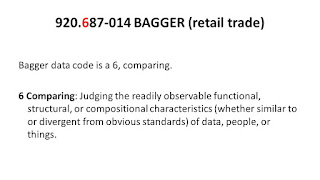
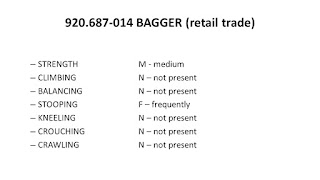
The first hypothetical question to the vocational expert had no exertional limitations; no ladders, ropes, scaffolds, heights, proximity to moving machinery, hazards, or commercial driving; and limited to simple routine tasks.  Vocational expert identifies bagger (920.687-014) with 136,000 jobs in the nation. 

ALJ interrupts and adds light exertion to the residual functional capacity.  Vocational expert identifies cashier (211.462-010) with 682,000 jobs in the nation and garment sorter (222.687-014) with 72,000 jobs in the nation. 

ALJ adds no work with small objects, no printed circuit boards.  The vocational expert states the prior testimony still applies.  The ALJ asks about coins.  Vocational expert stands her ground.  ALJ asks for another occupation anyway.  The vocational expert identifies housekeeper (323.687-014) with 377,000 jobs in the nation.

The case is about a mental impairment.  The ALJ asks the vocational expert to assume occasional interaction with the public, coworkers, and supervisors.  The vocational expert eliminates cashier and bagger.  The vocational expert offers an alternate occupation -- office helper (239.567-010) with 62,000 jobs in the nation.  The vocational expert describes office helper as more or less filing, working more with office machinery than people and certainly not dangerous. 
ALJ: Any questions, counsel?
ATTY:  Yes.
We have office helper, housekeeper, and garment sorter to address.  I first focus on office helper.  I ask the vocational expert to read the DOT narrative into the record.  She doesn't have it in front of her, so I read it to her. Office helpers:
Performs any combination of following duties in business office of commercial or industrial establishment:
Furnishes workers with clerical supplies.
Opens, sorts, and distributes incoming mail, and collects, seals, and stamps outgoing mail.
Delivers oral or written messages.
Collects and distributes paperwork, such as records or timecards, from one department to another.
Marks, tabulates, and files articles and records. May use office equipment, such as envelope-sealing machine, letter opener, record shaver, stamping machine, and transcribing machine.
That sounds different than what you described.  The vocational expert concedes. 
Q: What is the occupational group in which office helper is classified by Labor?
A: SOC 43-5021.
Q: What is the name for that group.
A: Couriers and messengers.
Q: Is it your testimony that couriers and messengers have occasional contact with other people?
A: I rely on my experience.
Q: If I represent to you that the Department of Labor classifies this occupation as having frequent or constant contact with other is 99% of jobs, do you have a statistical basis for rebutting that classification?
A: No.
The occupation might be out but only if the residual jobs do not add up to 62,000 jobs. 
Q: Do you agree with the estimate from Labor that this group represents 95,000 jobs?
A: That sounds right.  
At this point, the ALJ continued the hearing to that afternoon.  When we come back, the ALJ states that she reviewed her notes and the vocational expert in this case was just not reliable.  Knocked out the witness. 

The next item on the cross list was housekeeping cleaners.  That kind of work requires more than occasional contact with others in 95% of jobs.  Maids and housekeeping cleaners work with a group or team in 99% of jobs.  Maids and housekeeping cleaners work work part-time in 60% of jobs. 

The last occupation on the list is garment sorter.  This occupation belongs to the ubiquitous group of production workers, all other (SOC 51-9199).  Production workers are not addressed in the O*NET.  The 2018 data set of the ORS describes the occupational group as 53% unskilled and not more than 36.1% light exertion.  The 2018 data set does not have the cognitive data, so I would have flipped back to the 2017 data set.  Contact with regular contacts is continuous in 24% of jobs and more than once per hours in 43.8 % of jobs.  The 2016 data collection that lead to the 2017 data release had four categories for contact with regular contacts and contact with other contacts:
(A) Constantly, every few minutes.
(B) More than once per hour, but not constantly.
(C) More than once per day, but not more than once per hour.
(D) No more than once per day; includes never.
(A) = constant; (B) = frequent; (C) = occasional; and (D) = seldom or never.  

BLS did not collect cognitive data for the 2018 data set but tells me that it will in the 2019 data set.  The 2018 Occupational Requirements Survey (ORS) Collection Manual, Version 4.0 lists the same hierarchy.  

The data exists and the vocational experts cannot rebut the statistical data from Labor.  They can differentiate occupations based on variance within the economy but when the variance is addressed by the data, then the vocational expert is there as a guide and not much more.  

To have all of this data ready on the fly, I use www.occucollect.com.  When the vocational expert relies on Job Browser Pro, I use the program post hearing.  When the vocational expert relies on the Occupational Employment Quarterly, I address the equal distribution method as unreliable. 

Tuesday, December 11, 2018

Comments on the SCOTUS Blog - Biestek v. Berryill

The SCOTUS Blog - Biestek v. Berryill summarizes from a non-Social Security perspective the oral argument. The underlying theme of the blog is to emphasize the lack of publicly available data to put any kind of reliability on job numbers in the national economy. That, my friends, is based on an ignorant understanding of the evolving data.

Having read the relevant part of the transcript in Biestek, it is clear to me that the vocational expert had no discernible recognized methodology. It is a gross rounding down of aggregate job numbers for large occupational groups. It is wholly unreliable.

The vocational expert identified nut sorter (DOT 521.687-086) representing 120,000 jobs. The vocational expert had already identified a light inspector job representing 450,000 jobs in the nation. The entire occupational group represented 489,750 jobs in the nation as of May 2014. Bureau of Labor Statistics, U.S. Department of Labor, Occupational Employment Statistics, Occupational Employment and Wages, May 2014, 51-9061 Inspectors, Testers, Sorters, Samplers, and Weighers.

The vocational expert identified final assembler (DOT 713.687-018) representing 240,000 jobs. Production Workers had an estimated 217,500 jobs in every exertional and skill level. Bureau of Labor Statistics, U.S. Department of Labor, Occupational Employment Statistics, Occupational Employment and Wages, May 2014, 51-9199 Production Workers, All Other.

Putting together the testimony relied upon by the ALJ and the other testimony rendered irrelevant by the change in the residual functional capacity assessment, it is clear that the vocational expert in Biestek was at least reckless about the truth an no one called her on it. Use the O*NET Crosswalk to check the DOT to SOC correlation and the number of occupations in the two groups containing mostly jobs that are not sedentary and jobs that are not unskilled (1,590 occupations in production workers and 782 occupations in inspectors, testers, sorters, samplers, and weighers).

The equal distribution method (Occupational Employment Quarterly) does not support the absurd testimony by the vocational expert in Biestek. The occupational density model (Job Browser Pro) does not support that testimony. The results of research in the Occupational Requirements Survey would not support the testimony.

Calculating the density by occupation and industry beats equal distribution for job numbers. Using the ORS beats them both. The available data ruins the testimony given in Biestek and the court should rest assured that the testimony in this case was not reliable, period.


Friday, September 7, 2018

The Heavyweight Bout of the Century -- Purdy versus Chavez

The battle royale is now set over the question of whether the vocational expert must have some logical defense of the job numbers regurgitated at a Social Security hearing.  In the blue corner, we have the Seventh Circuit on-demand rule culminating in Chavez v. Berryhill.  In the red corner, we have the rest of the country typified by the approach announced in Purdy v. Berryhill.

Purdy is simple.  The vocational expert identified job numbers using Job Browser Pro.  Counsel for Purdy asked the VE how JBP worked.  The VE didn't really know but claimed that it was generally accepted.  The SkillTran team puts out a generally reliable product.  Some of the industry codes are suspect, but the methodology is sound in using industry designations to winnow down job numbers.  Purdy's conclusion:
This is not to say that we could go to the extreme of approving reliance on evidence of the software numbers offered by a witness who could say nothing more about them than the name of the software that produced them. But that is not the case here. The VE, whose qualifications Purdy did not challenge, testified that the job numbers were from the Bureau of Labor Statistics and were stated in reference to job descriptions in the DOT; that is, they were specific to jobs, not to broad amalgams of jobs, some of which an applicant might be able to perform but not others. The VE testified that the software's conclusions on the described basis were generally accepted by those who are asked to give the sort of opinions sought here. She testified, in other words, to a reliable and practical basis of fact on which analysis was performed, and to a wide reputation for reliability.
Naming the software is not enough.  Knowing the source (BLS) of job numbers; that JBP stated DOT-specific job numbers not entire OES-SOC groups of job numbers; and the generally accepted nature of JBP in combination are sufficient.  What is missing from the Purdy presentation is any evidence that JBP was wrong about any of its job number conclusions.

Chavez set the stage as a fight between JBP and the Occupational Employment QuarterlyChavez does not disagree with the factors outlined in Purdy:
Establishing the reliability of a job-number estimate does not require meeting an overly exacting standard. Many variables combine to create uncertainty in a VE's job-number estimate.
...

VEs are neither required nor expected to administer their own surveys of employers to obtain a precise count of the number of positions that exist at a moment in time for a specific job. Think of the difficulty, if not impossibility, of acquiring the data necessary to tally how many residential laundry worker jobs exist throughout the United States or even in the Midwest. The VE necessarily must approximate, and there is no way to avoid uncertainty in doing so.
After discussing previous encounters with the equal-distribution method, Chavez highlights the problem with the vocational expert's testimony in this case:
And all the record shows is that the VE preferred the job-number estimates produced by the equal distribution method over those from the occupational density method. What is entirely lacking is any testimony from the VE explaining why he had a reasonable degree of confidence in his estimates. The VE, for example, could have drawn on his past experience with the equal distribution method, knowledge of national or local job markets, or practical learning from assisting people with locating jobs throughout the region, to offer an informed view on the reasonableness of his estimates. The absence of any such testimony left the ALJ without any reasoned and principled basis for accepting the job-number estimates.
Whereas the VE in Purdy stated reliance and general confidence in JBP, the VE in Chavez rejected JBP as reporting too small of numbers and just a blanket preference for the equal distribution method used in the OEQ.  The VE did not knowing the source of job numbers; could not state that the job numbers were DOT-specific; and could not or did not state that the OEQ was generally accepted as a reasonable estimate of job numbers.

Are Chavez and Purdy in conflict?  I don't think so.  They are factually distinct.  Purdy could truthfully rely on the accepted nature of JBP as an occupational density model for reporting job numbers by DOT code, it does.  Chavez could not truthfully state that VE's believe that the OEQ constitutes a reasonable basis for reporting job numbers by DOT code, it doesn't.   The 2017 Vocational Expert Handbook requires the defense described in Chavez and Purdy:
You should be prepared to explain why your sources are reliable.
NOTE: During your testimony, maintain easy access to any sources you rely upon, as the ALJ, claimant, or representative may have questions about your sources. Particularly, any sources outside of those listed under 20 CFR 404.1566(d) and 416.966(d).
See page 38.  Absent a reasonable statement of reliability of methodology, the testimony is not substantial evidence under either Chavez or Purdy.  In the next few posts, we will talk about questions to ask the VE on cross about the OEQ and JBP to bolster the rejection of the OEQ or disassemble reliance on JBP in some cases.

We close today with the observation in Chavez:
We also recognize and underscore that VEs cannot be expected to formulate opinions with more confidence than imperfect data allows. Nor is it our place to enjoin use of the equal distribution method. What we do require, though, is more than what supported the ALJ's decision here.
The COSS should tell her ALJs to stop accepting testimony based on the equal distribution method. 

Wednesday, September 5, 2018

Proof of Use of the Equal Distribution Method of Calculating Job Numbers by the OEQ

Several vocational experts have testified that the Occupational Employment Quarterly uses a very complicated occupational density model to estimate job numbers based on exertion and skill level.  The testimony that the vocational experts give is demonstrably false.

I broke down and order the 4th Quarter 2017 OEQ and will likely buy the 2018 OEQ next year.  Representatives should have a copy of the OEQ to use in cross-examination.  The point is to prove that the OEQ uses an equal distribution method of stating job numbers.  I converted the rows used in the OEQ into columns.  I divided the total number of jobs by the total number of occupations.  That is the average number of jobs per DOT code.  I took the number of jobs reported in each of the 12 columns (rows on my chart) and divided that reported number by the average I previously computed.  The last column of my calculations is rounded to the nearest hundredth.  I then totaled my raw calculation and the rounded calculation just for fun.  Here is what I got:

SOC-OES Code
51-9199
Calculations
Census Code
8965
SOC - OES CODE TITLES
Production Workers, All Other
Average

Current # Employed
771,069
485.254248

# DOT Titles
1589
 Quotient
Rounded
UNSKILLED EMPLOYMENT
(SVP=1 OR SVP=2)
Sed.
25,233
51.99954479
52.00
Light
196,528
405.000061
405.00
Med.
89,772
184.9999261
185.00
Heavy +
20,866
43.00013877
43.00
SEMI-SKILLED EMPLOYMENT
(SVP=3 OR SVP=4)
Sed.
17,954
36.99916091
37.00
Light
162,560
334.9996434
335.00
Med.
119,858
247.0004137
247.00
Heavy +
36,879
75.99933469
76.00
SKILLED EMPLOYMENT (=SVP >4)
Sed.
3,397
7.000453915
7.00
Light
43,673
90.00024252
90.00
Med.
47,555
98.00017249
98.00
Heavy +
6,794
14.00090783
14.00


TOTALS:


1589.0000
1589

And there we have it.  Mathematical proof of equal distribution of the job numbers based on the number of DOT codes within each exertion-skill level intersection.  The same method works for every SOC-OES/Census code reported in the OEQ.  I know; I checked.