Showing posts with label POMS. Show all posts

Friday, August 4, 2023

Since Hearings are Conducted in English, I Suggest that We Define Our Terms with a Dictionary -- TEAMWORK

In a recent disability hearing, the ALJ directed the vocational witness to assume "no teamwork." I really get excited when I hear this limitation because it means that the person cannot work, I will win this case. I start with John Donne's For Whom the Bell Tolls:

No man is an island,
Entire of itself.
Each is a piece of the continent,
A part of the main.
If a clod be washed away by the sea,
Europe is the less.
As well as if a promontory were.
As well as if a manor of thine own
Or of thine friend's were.
Each man's death diminishes me,
For I am involved in mankind.
Therefore, send not to know
For whom the bell tolls,
It tolls for thee.

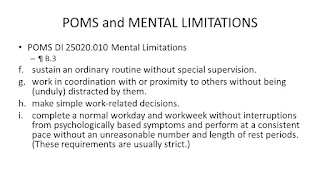
First line, there it is, no man is an island. We are all interconnected in life, death, and especially in work. SSA knows this. POMS DI 25020.010.B.3 describes worker functions critical to performing unskilled work:

             3. 

Mental Abilities Critical For Performing Unskilled Work

g.  work in coordination with or proximity to others without being (unduly) distracted by them.

 The Department of Labor confirms the concept in the Occupational Requirements Survey. 

Series ID: ORUC1000000000001186
Not seasonally adjusted
Series Title: Percent of civilian workers; with basic people skills
Requirement: Cognitive And Mental Requirements
Occupation: All workers
Estimate: with basic people skills
YearPeriodEstimate
2022Annual38.8
Only 38.8% of jobs require basic people skills? That means that basic people skills are not required in 61.2% of jobs! That's right Bucko, those jobs require "more than basic people skills." 
Series ID: ORUC1000000000001187
Not seasonally adjusted
Series Title: Percent of civilian workers; with more than basic people skills
Requirement: Cognitive And Mental Requirements
Occupation: All workers
Estimate: with more than basic people skills
YearPeriodEstimate
2022Annual61.2
That is why I get excited when I hear "no teamwork." The person is unemployable. The child that comes home with a report card that plays well with others occasionally but does not play well with others 67% of the day or more has serious problems at school and has a very hard life ahead. No person is an island. We are all interconnected. For the lay person out there, lawyers are morbid people -- the worse the problem the more animated we become.

So the vocational witness testifies that a person limited to no teamwork can perform a couple hundred thousand jobs. I ask how the witness understands "teamwork." I get a bucket of drivel that defines teamwork to the point where people are in each other's pockets constantly during the day. I ask the witness to assume that teamwork means:
: work done by a group acting together so that each member does a part that contributes to the efficiency of the whole

I inform the witness and the ALJ that the definition comes from Merriam-Webster online dictionary.  

Well, if you want to define the term that way, then there are no jobs.

Let's be really clear on this point, that is no my definition of teamwork, it is the culturally and linguistically accepted meaning of the work as reported by the dictionary. This is not Humpty Dumpty:

“When I use a word,” Humpty Dumpty said in rather a scornful tone, “it means just what I choose it to mean—neither more nor less.”
Witnesses do not get to use their own private definitions of words. Words have meaning and if we do not agree on the meaning of words, we cease to have the ability to communicate. The loss of communication for a social species means that we cease in the ability to be social. I read it in a book one time, maybe more, perhaps you have seen it too:
It is not good for the man to be alone. 
The administrative process is hard enough but when the administrative process signals a breakdown in culture, when the witnesses torture themselves to get to an outcome that is simple unsustainable, when words cease to mean what we have agreed as a culture that they mean, then we are all in serious trouble.


Talk me off the ledge.


___________________________

Suggested Citation:

Lawrence Rohlfing, Since Hearings are Conducted in English, I Suggest that We Define Our Terms with a Dictionary -- TEAMWORK, California Social Security Attorney (August 4, 2023) https://californiasocialsecurityattorney.blogspot.com

The author has been AV-rated since 2000 and listed in Super Lawyers since 2008.


Wednesday, November 14, 2018

Transferability of Skills -- POMS Updated

We discussed transferability of skills three years ago in Transferable Skills Analysis.  Last month, the Commissioner updated the TSA process description in POMS.  The discussion of Transferable Skills Analysis (TSA) as to the regulations and ruling continue to apply.  This piece updates to the current POMS 25015.017.  

Part A consists of a list of Medical-Vocational Guidelines rules that direct decisions when skills either transfer or do not transfer.  POMS is a little off on the list.  When a rule that assumes the absence of transferability directs a conclusion of "not disabled," the transferability of skills is irrelevant.  Part B lists four factors in TSA:
Transferability of skills is an issue when all four of the following are true:
1. Transferability is material to the determination;
2. The individual’s residual functional capacity (RFC) or mental residual functional capacity (MRFC) prevent the performance of past relevant work (PRW);
3. PRW has been determined to be skilled or semiskilled; and
4. The claimant does not have a mental impairment that prevents him or her from doing skilled and semiskilled work.
Part C defines skills and gives examples of what are not skills:
• Answering a standard telephone, operating a two-way radio or intercom
• Basic driving ability
• Filing papers
• Greeting customers
• Basic food preparation
• Performing routine money handling tasks
Part G cautions:
Before beginning the TSA, make sure all of the following are true:
• Transferability is material to the disability determination;
• The claimant has semi-skilled or skilled PRW;
• The claimant’s RFC or MRFC does not prevent him or her from using his or her skill(s) in other work; and
• The claimant’s description of PRW provides enough detail to perform a TSA.
 Part I is the interpretation of the skills regulation
Step 4 – Search for occupations related to the claimant’s PRW using the same or similar:
• guide for occupational exploration (GOE) code;
• materials, products, subject matter, and services (MPSMS) code;
• work field (WF) code;
• occupation group (first three digits of DOT code); or
• industry designation.
The phrase same or similar comes directly out of the regulation (d)(2):
(ii) The same or similar tools and machines are used; and
(iii) The same or similar raw materials, products, processes, or services are involved.
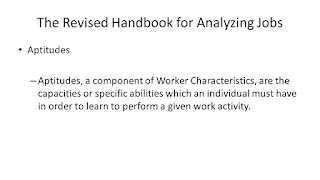
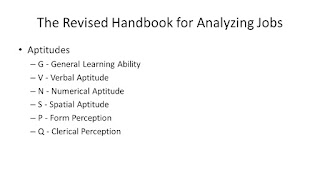
 The Revised Handbook for Analyzing Jobs defines work fields and MPSMS codes:
Work Fields: These are groupings of technologies and socioeconomic objectives that reflect how work gets done and what gets done as the result of the work activities of a job, or in other words, the purpose of the job. They summarize and classify the overall objectives of work, such as processing of materials, fabricating products, utilizing data, and providing services. The 96 Work Fields are defined and discussed in Chapter 4.
Materials, Products, Subject Matter, and Services (MPSMS): MPSMS include (a) basic materials being processed, such as fabric, metal, or wood; (b) final products being made, such as automobiles or baskets; (c) data, when being dealt with or applied, such as in dramatics or physics; and (d) services being rendered, such as barbering or dentistry. Chapter 5 contains information about this component.
 The RHAJ continues in Chapter 4 to define the concepts of work fields:
Work Fields. a component of Work Performed. are categories of technologies that reflect how work gets done and what gets done as a result of the work activities of a job: the purpose of the job. There are 96 Work Fields identified for use by the USES for classification of all jobs in the economy in terms of what gets done on the job.
Work Fields range from the specific to the general and are organized into homogeneous groups, based on related technologies or objectives. such as the movement of materials. the fabrication of products, the use of data. and the provision of services. Each Work Field is identified by a three-digit code, a brief descriptive title, and a definition. In many cases. a comment is included which enlarges upon
the definition and limits or extends the application of the Work Field. Also, cross-references are frequently included which distinguish one Work Field from other related Work Fields.
Following the definition is a list of methods verbs which illustrate the applicatiOfi of the Work Field. This list is not intended to be exhaustive. but merely representative, of the ways in'.which the objective of the Work Field can be accomplished. Note that the methods verbs listed as examples do not include those appearing in the title or definition for that Work Field. inasmuch as they are implicit in the Work Field. Some methods verbs are used as illustrative examples in more than one Work Field; however, their meanings may differ in the various listings.
It is important to understand that the concept of Work Fields involves consideration not only of the overall objective or purpose of a job, but also how the objective is attained; that is, the means by which the objective of the job is met. MTEW A are instruments and devices used by the worker to achieve the objective of the job. MTEW A are directly related to, and help describe, specific methods verbs. 
The job of a worker who performs in a first-line supervisory or helper capacity is assigned the same Work Field(s) as that of the jobs of the workers supervised or helped, because the technological objectives are the same as those of the workers supervised or helped. It is incorrect to assign Work Field 295-Administering to such supervisory jobs; or 0 II-Material Moving to helper jobs. For Things jobs that are machine-related. the Work Field is based upon what the machine does. For example, the job of a worker who tends a machine that smooths and polishes bores of shotgun barrels is assigned Work Field 051-Abrading. Prefixes. such as un or reo are implicit in the definition of a Work Field. For example. Material Moving includes unloading and removing; Filling-Packing-Wrapping includes unpacking, unwrapping. etc.
 Chapter 5 defines the concepts of MPSMS codes:
The Work Perfonned component of MPSMS includes:
Basic Materials processed, such as fabric, metal, or wood.
Final Products made, such as automobiles; cultivated, such as field crops; harvested, such as sponges; or captured, such as wild animals.
Subject Matter or data dealt with or applied. such as astronomy or journalism.
Services rendered, such as barbering or janitorial.
MPSMS is the final link in a chain describing (1) what the worker does (Worker Functions); (2) what gets done (Work Fields); (3) to what (MPSMS).
The determination and assignment of an appropriate MPSMS code and title for a specific job is essential (1) to place the job in its occupational group of the DOT and (2) to contribute to an understanding of the basic knowledge required of the worker. The assigned Work Fieldls) and MPSMS together answer the question, "What does the worker need to know?"
MPSMS categories are closely related in organization and content to categories in the Standard Industrial Classification Manual (SIC) and to educational classifications of subject matter. Some categories of MPSMS are tangible and some are intangible. Categories of tangibles cover materials and products, such as Grains and Alcoholic Beverages. Categories of intangibles involve specialized knowledge or services, such as Dramatics and Air Transportation, and cannot be expressed by listing a material or product.
 Chapter 11 defines the Guide for Occupational Exploration:
The Guide for Occupational Exploration (GOE) provides users with information about the interests, aptitudes, adaptabilities, and other requisites of occupational groups. The GOE is designed for use in self-assessment and counselor-assisted settings to help people understand themselves realistically in regard to their ability to meet job requirements.
 Because of the incorporation of worker functions (the middle three digits of every DOT code), we look to Chapter 3 for the definition of those data-people-things codes:
Worker Functions, one of the three components of Work Performed, are activities which identify worker relationships to data, people, and things.
The takeaway in comparing what the process requires now and what it required three years ago is that nothing material has changed.  The Commissioner has a stable understanding and interpretation of the TSA process.  That understanding of the skills regulation warrants Skidmore deference if not Auer deference.  

Wednesday, June 13, 2018

Transferable Skills to Telephone Solicitor, Part II -- the DOT Data Set

Vocational expert assumes the presence of a work history that includes selling cable television service to walk-in customers.

    Contacts homeowners, apartment managers, and other prospects to sell cable television service: Compiles list of prospective customers from lists of homes that do not have cable television and lists of residential addresses with names of owners and occupants. Travels throughout assigned territory to call on prospective customers in their homes to solicit orders. Performs duties as described under SALES REPRESENTATIVE (retail trade; wholesale tr.) Master Title.
GOE: 08.02.06 STRENGTH: L GED: R4 M3 L4 SVP: 3 DLU: 88

The ALJ directs the VE to assume a limitation to sedentary work.  Vocational expert identifies the occupation:

299.357-014 TELEPHONE SOLICITOR (any industry) alternate titles: telemarketer; telephone sales representative
    Solicits orders for merchandise or services over telephone: Calls prospective customers to explain type of service or merchandise offered. Quotes prices and tries to persuade customer to buy, using prepared sales talk. Records names, addresses, purchases, and reactions of prospects solicited. Refers orders to other workers for filling. Keys data from order card into computer, using keyboard. May develop lists of prospects from city and telephone directories. May type report on sales activities. May contact DRIVER, SALES ROUTE (retail trade; wholesale tr.) 292.353-010 to arrange delivery of merchandise.
GOE: 08.02.08 STRENGTH: S GED: R3 M3 L3 SVP: 3 DLU: 88

The regulations describe transferability:
(2) How we determine skills that can be transferred to other jobs. Transferability is most probable and meaningful among jobs in which—
(i) The same or a lesser degree of skill is required;
(ii) The same or similar tools and machines are used; and
(iii) The same or similar raw materials, products, processes, or services are involved.
We examine each of those elements.  It is clear that the SVP for sales representative is 3 and the SVP for telephone solicitor is also a 3.  Same or lesser degree of skill is required.

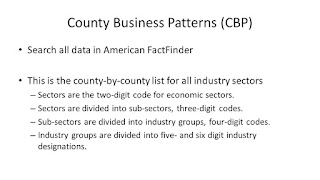
The concept of tools and machines is denominated by the DOT-data set as work fields (WF).  The concept of raw materials, products, processes, or services is described in the DOT-data set as Materials, Products, Subject Matter, and Services (MPSMS).  SSA recognizes this in POMS DI 25015.017, Transferability of Skills Assessment (TSA).  Paragraph I, step 4 tells the adjudicators to search for same or similar:
  • guide for occupational exploration (GOE) code;
  • materials, products, subject matter, and services (MPSMS) code;
  • work field (WF) code;
  • occupation group (first three digits of DOT code); or
  • industry designation.
Compare the GOE:  08.02.06 versus 08.02.08.   The first four digits are the same.  The codes are similar.  The data for sales representative:
WORK    code: 292      MERCHANDISING-SALES
MPSMS   code: 869      COMMUNICATION SERVICES, OTHER
The data for telephone solicitor:
WORK    code: 292      MERCHANDISING-SALES
MPSMS   code: 885      SALES PROMOTION SERVICES
The work fields are the same.  No further inquiry is necessary.

The MPSMS codes diverge after the first digit.  We examine that element.  MPSMS group 860, communication services is described in the Revised Handbook for Analyzing Jobs:
This group includes aural or visual communication and broadcasting services provided by tele
phone and telegraph operators, radio and television broadcasters, radar-station operators, telephoto operators, and related workers. Newspapers, magazines, and related printed and published products are classified in Group 480. Telephone message services are classified in
Group 890. Lecturing and public-speaking services are classified in Group 930. Installation,
maintenance, and repair of communication structures and equipment are classified in Group
360 and 580. respectively.
The RHAJ describes MPSMS 869 as:
Communication Services, n.e.c. (cablevision, missile tracking and radar, telephoto, ticker tape, etc.)
That is the nature of the work as a sales representative.

The RHAJ describes MPSMS 880 as:
This group includes retail and wholesale trade, route sales and delivery, auctioneering, vending, rental, sales promotion, merchandise displaying, and related merchandising services rendered by commodity-sales personnel, vendors, peddlers, newspaper carriers, sales-route drivers, auctioneers, rental clerks, cashiers, demonstrators, models, window dressers, commercial decorators, professional shoppers, buyers, and similar workers. Sales personnel engaged in selling finance, insurance, real estate, transportation, utilities, advertising, and related services are classified according to the services being sold.
MPSMS code 885 is:
Sales Promotion Services (demonstrating, modeling, etc.)
Our friends at SkillTran, the publishers of Job Browser Pro, Occubrowse, and other products describes the landscape of the TSA for SSA purposes as:
SkillTRAN implements its transferability analysis as follows: 
Directly Transferable Occupations share at least one of the three digit WORK fields known from each job of the past work history AND have at least one of the same three digit MPSMS codes from any of those jobs done in the past. Directly transferable occupations have primary job duties that are very similar to past work. Little or no learning of job duties is anticipated. 
Closely Transferable Occupations are in combination WORK fields (which involve multiple work technologies) AND have at least one of the same three digit MPSMS codes from past work history. Some learning of a few job duties may be anticipated. 
Generally Transferable Occupations share at least one of the two digit WORK fields from the past work history AND have at least one of the two digit MPSMS fields from the past. Two digit coding by WORK and MPSMS clusters occupations into generally related groups that may not share the same specific skills as developed in the past. Some learning of essential job duties is likely to be necessary. 
Directly Related Occupations share at least one of the three digit WORK fields known from the past work history but could involve any kind of MPSMS. Some moderate to significant on-the-job training can be anticipated. Formal training may be necessary for some occupations. 
Generally Related Occupations share at least one of the two digit WORK fields known from the past work history but could involve any kind of MPSMS. Significant on-the-job or formal training can be anticipated.
Unskilled Occupations (SVP = 1 or 2) can be learned within 30 days and require no previous occupational experience. There are a total of 3,125 unskilled occupations in the DOT.  
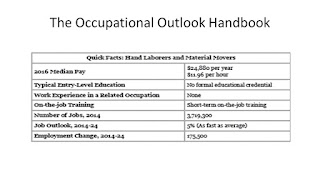
 The transition from sales representative to telephone solicitor does not have transferable skills.  They are directly related occupations.  The same three digit work fields and unrelated MPSMS codes that will involve moderate to significant on-the-job training.  Of course, the only reason that no one needs training to perform the occupation of a telephone solicitor is in reality unskilled per the OOH.

Friday, April 27, 2018

Questions on Fees from NOSSCR Spring 2018

We ran out of time at the NOSSCR conference in the discussion of attorney fees.  I answer those questions here:
I have had several instances recently where I did all the case prep, but then did not rep the client at the hearing (fired the week before the hearing, client with dementia doesn't remember hiring me and then hires another attorney, client became unresponsive). The ALJs awarded fees in all cases after fee petition, but fee is not withheld. Clients refuse to pay-- what do I do?
 The agency does not withhold fees for a discharged or withdrawing representative.  You have to collect the fee from the claimant or representative payee.  The only way to turn that award into something collectible is to turn it into a state court judgment.  Consult your state rules about suing your client -- most carriers frown on it and if the claimant is demented, that person may try to relitigate the fee award from the ALJ.
Is it proper for an ALJ to reduce a requested fee on a fee petition on the basis that the fee petition was "delayed," e.g., 6 months after the Notice of Award was issued?
Is there a reason for the delay other than the press of business?  If the fee petition seeks less than the entire withholding, then the delay has prejudiced the claimant by delaying the receipt of the residual withholding.
Do we have any recourse for this scenario: we had an AC remand awarded upon second hearing for a closed period of benefits. Even though the rep paperwork and fee agreement were on file, SSA failed to withhold our fee. The client won't return our calls. HELP! 
I successfully represented a client and the Judge approved the fee agreement.  The client was paid the full amount of the back pay but SSA mistakenly did not withhold my fee.  Suggestions... 
Ask the field office in an SSI case or the processing center/OCO in a DIB case to create an overpayment and pay you directly -- assuming that you are eligible for direct payment.  You need to document your collection efforts to qualify for the creation of the overpayment.  The agency will not declare an overpayment without that showing nor if the claimant is deceased.
I've had problems in which SSA is failing to release past-due benefits to my clients while my fee petitions are pending. Shouldn't SSA be releasing 75% of those benefits to my clients in the interim? (Instead of telling my clients that "your lawyer is holding up payment of your benefits?")
A writ of mandate comes to mind.  Don't file one, threaten to file one.  If this is a Title II claim, it is a rogue in the office.  If this is a Title XVI claim, the claimant gets the benefit in three payments with the bulk coming at the end of 12 months.
How should I handle getting a 1099 from SSA every year? Why does no one ever directly address this with NOSSCR or SSA or IRS?
File a schedule C that declares the income reported on the 1099 and then report the transfer of the entire corpus of those funds to the firm or other entity.  NOSSCR cannot control the IRS reporting requirements; nor does SSA.
 how do you address the fee with the client at signup in cases where the ALJ finds disability 5 1/2 months prior or say 7 months prior?
Anticipate the scenario as part of the fee agreement.  You can reserve the right to seek administrative review of the fee agreement or opt into a fee petition process in those cases.  We take risk in representing claimants of either a small fee or no fee.  This is part of the process.
What is the review process available if the Payment Center disapproves your fee agreement after an ALJ approved it (Assuming the PC disapproved for an incorrect reason)?
Seek administrative review of the fee agreement disapproval by the PC.  Due process requires a notice and opportunity to be heard.   See HALLEX I-1-2-49
Prior attorney withdraws but does not waive.  Does SSA send copy of favorable decision or award letter.  You file fee petition.  How does prior attorney know when to file?
SSA notifies the representative to file a fee petition and/or the representative files a fee petition on discharge/withdrawal. 
If a client fires a rep and hires someone else, and the previous rep withdraws, why does the new rep still have to do a fee petition?
Because the withdrawing representative still has the right to seek a fee.  If the previous representative waives, then the ALJ can approve the current representative fee's fee agreement.
It took almost a year for my fee agreement to be approved. SS told me my clients full backpay would not be disbursed until my fee agreement was approved. This didn't happen. They gave her everything. Now I have to collect from her direct. How can I prevent this from happening in the future?
The backpay should be released and the withholding held back.  If I were told that SSA would not release the PDB until my fee was set, I would demand that the agency release that 75% of the PDB to the client.  As to release of the withholding, it happens because the agency makes mistakes.